

An actionable guide to customer research, buyer psychology, and creative strategy for DTC founders, small businesses, freelancers, video editors, and Meta advertisers.
A customer avatar should help you write the next ad. If yours lives in a slide deck and only says “women ages 35–55 who enjoy skincare,” it probably isn’t doing much for your marketing.
That description tells you something about who may buy. It doesn’t tell you why someone stops scrolling, what they have already tried, what makes them hesitate, or what they need to hear before putting a product in their cart. Those questions matter far more when you’re facing a blank script, a struggling campaign, or a request to produce ten new video variations by Friday.
I think of a useful ecommerce customer avatar as a working picture of a group of buyers who share a recognizable motivation or situation. It is not an imaginary biography with a fake name, a stock photo, and a favorite coffee shop. It is a set of researched clues you can use to make advertising more relevant—and a set of assumptions you can challenge with real results.
This guide explains how to build one from the ground up, how to turn it into ad concepts, and how to avoid the common trap of making your audience so narrow that no one else can see themselves in your message. The examples are teaching scenarios, not reports of actual client test results.
Why Most Ecommerce Buyer Personas Never Make It Into an Ad
Somewhere in a brand’s shared drive, there is often a document titled “Ideal Customer Persona.” It may contain age ranges, income brackets, household size, a few hobbies, and a cheerful sentence about wanting a healthier lifestyle. The team fills it out during a workshop, agrees it looks reasonable, and goes back to making ads much as it did before.
The problem isn’t that demographic information is useless. The problem is that it rarely tells a creative team what to say. Consider the sentence “Our audience is women in the United States aged 40 to 60.” What would the first line of the video be? Which objection should the founder answer? What demonstration deserves the first five seconds? You still don’t know.
Now consider something more specific: “A shopper wants a simple haircare routine but has an unopened bottle from the last product she bought after seeing glowing social-media reviews.” Suddenly you can hear the conversation. She has a desired outcome, a disappointing past experience, and a reason to be skeptical. That is a much better starting point for a script—provided customer research supports it.
A practical avatar isn’t a guarantee of sales. Product quality, price, landing pages, fulfillment, competitive pressure, and measurement all matter. Still, the avatar gives the creative team a sharper question to answer than “What else can we post this week?”
What Is an Ecommerce Customer Avatar?
An ecommerce customer avatar is a research-based description of a group of prospective buyers who share motivations, experiences, concerns, or buying behaviors relevant to a specific product or offer. Marketers may also use the terms buyer persona, customer persona, or target customer profile. In everyday conversations these terms overlap, although a formal ideal customer profile (ICP) can serve a different purpose, especially in B2B sales.
An avatar is most useful when it can influence a decision. It should help answer which audience problem to feature, which words sound familiar, which proof seems credible, which objection matters, and what next step feels reasonable. If you cannot turn your profile into a message, it may be too generic—or based on the wrong information.
Here’s a simple test. Finish this sentence: “For people who ______, our ad should show ______ because they need to believe ______ before they buy.” If you can complete it using research, you are closer to an actionable avatar than someone with three pages of demographics and no creative direction.
Core avatar refers to the broader shared motivation or situation. A sub-avatar is a more focused group within it, shaped by another relevant detail. For example, “people who want better sleep” is broad. “Parents trying to improve sleep because morning sunlight wakes their child earlier than expected” is narrower. The second description gives you a situation to demonstrate without requiring a particular age or income.
The Five Building Blocks of a Customer Avatar
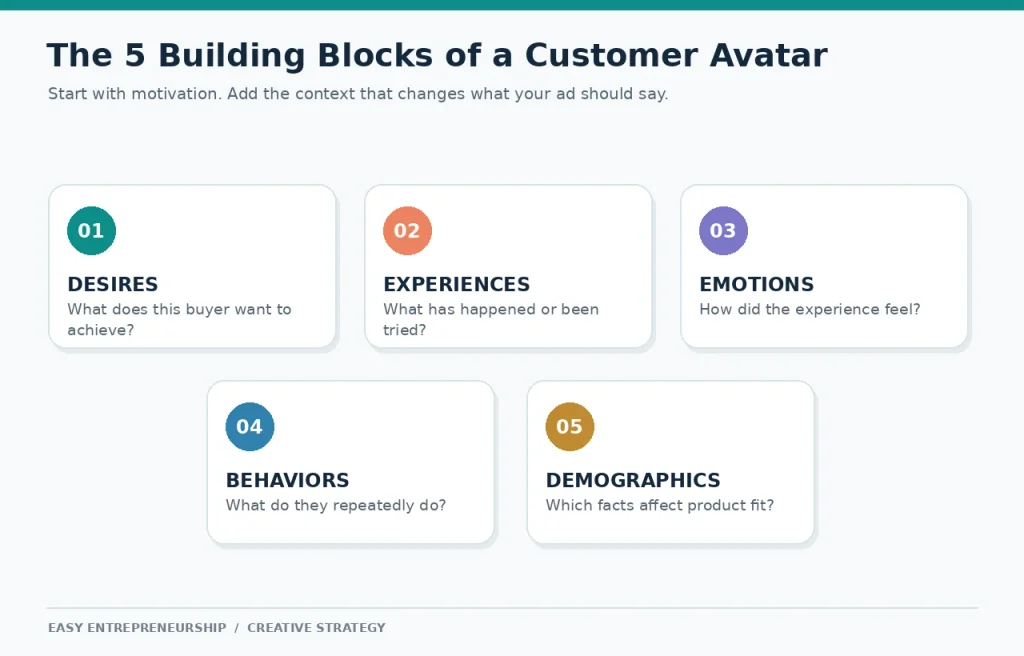
I find it useful to organize avatar research around five questions: What do people want? What have they experienced? How do they feel about it? What do they do as a result? And which factual characteristics genuinely change whether the product fits? These are not mutually exclusive boxes. They work together, and some customer statements belong in more than one until you examine them closely.
1. Desires: What Does the Customer Actually Want?
A desire is an outcome the customer wants to reach or a problem they want to stop dealing with. You can usually express it in everyday language: “I want to…” or “I need to…”. Think “I want my dog to walk calmly beside me” rather than “pet owners interested in accessories.” The first is a buying motivation; the second is a category label.
Broad desires such as “be healthy,” “save time,” and “feel confident” are real, but they appear in thousands of ads. They become more useful when you bring them closer to the customer’s daily life. “I want the morning routine to take less time” is already a more specific place to start. “I want to get my two children ready without spending fifteen minutes untangling hair” is even more concrete—if your product legitimately addresses that task.
To find desires, listen for verbs in reviews and conversations: fix, reduce, keep, make, avoid, finish, protect, enjoy, simplify. A buyer saying “Why does brushing take forever?” may be expressing a desire for a faster routine. However, don’t assume every buyer wants the same outcome. A customer seeking convenience and one seeking luxury might purchase the same item for very different reasons.
A helpful exercise is to write one clear desire per avatar. Trying to combine “save money, look younger, be healthier, and impress friends” into a single core profile usually produces a message that sounds as if it is talking to everyone. You can explore those other motivations as separate hypotheses later.
2. Experiences: What Has Happened to Them?
Experiences are the events and situations that shape the way someone approaches your category. Some are happening right now. Others happened months ago but still influence what the buyer believes.
I separate them into situational experiences and product experiences. A situational experience might be living in an apartment with thin walls, walking a dog that pulls on the leash, or waking up because sunlight enters a bedroom at dawn. A product experience might be buying blackout curtains that still let light through the edges or trying a grooming brush that proved difficult to clean.
The distinction matters because the experience itself should be stated plainly. “Bought expensive curtains and the room was still bright at 6 a.m.” describes an outcome. “Feels cheated by curtain brands” adds an emotion. “Now reads every one-star review before buying” adds a behavior. All three may be useful, but keeping them separate helps you see what you actually know.
Past experience also explains why identical product claims may land differently. First-time buyers may need a simple demonstration. Experienced buyers who have been disappointed may want to see limitations, materials, dimensions, or a side-by-side comparison. The product hasn’t changed; the audience’s history has.
3. Emotions: How Does That Experience Feel?
Emotion gives context to a buying decision. Two customers can go through the same situation and react very differently. A dog pulling during a walk might leave one owner embarrassed, another worried about safety, and a third simply irritated by the inconvenience. The exact feeling changes the message that will seem relevant.
A useful emotional observation connects the feeling to a specific situation. “She feels frustrated” is vague. “She feels frustrated after purchasing three products that promised a simpler routine but added extra steps” is more useful. You can understand the concern without exaggerating it.
Be careful here: marketing does not require diagnosing your customer’s mental state. You rarely know the precise emotion until someone tells you or you observe a clear pattern in their own words. Don’t turn ordinary uncertainty into a claim that someone is ashamed, anxious, or insecure. Respect is both a better creative principle and a safer advertising practice.
When you collect emotional language, record it as a quote where possible. “I just want a routine I can stick with” may be more valuable than your team’s invented label of “highly motivated beauty enthusiast.” The customer’s sentence can guide tone, rhythm, and the kind of reassurance the ad offers.
4. Behaviors and Habits: What Do They Repeatedly Do?
Behavior is where research often becomes immediately usable for creative production. A desire tells you the destination; a behavior shows what someone is doing on the way there. A buyer might compare ingredient lists, shop only when bundles are offered, watch three product demos before buying, or keep a notebook of products that did not work for them.
These details can make an opening feel familiar without claiming to know private information. Compare “Looking for a better skincare routine?” with “Still comparing ingredient lists before you add another serum to your cart?” The second speaks to a recognizable habit. Whether it performs better is an empirical question, not a certainty.
Behavior is also useful for identifying people with different backgrounds who share the same purchase pattern. A busy parent and a shift worker might both rely on a quick fifteen-minute home workout, even though their reasons are different. You can sometimes start with the shared routine and avoid unnecessarily excluding potential buyers by age or occupation.
When possible, learn the frequency and context of the habit. “Researches products” is less useful than “checks user photos and negative reviews before making a first purchase.” The second tells your team what visual proof may deserve space in an ad or product page.
5. Demographics: Which Facts Truly Matter?
Age, location, language, household structure, occupation, and other demographic characteristics can be important. A product may be designed for a particular age group, climate, household situation, or accessibility need. In those cases, demographic information helps determine whether a product fits and how it should be explained.
But I would not automatically lead with demographics. Someone’s age does not explain which product claim they doubt or whether they already tried three alternatives. A buyer’s actual experience often gives the creative team a more precise starting point.
Use demographics when they change product suitability, language, distribution, or a relevant context. Be especially careful with protected or sensitive characteristics and with advertising-platform rules. Do not imply that you know an individual’s health condition, personal hardship, identity, or other sensitive attributes from their behavior. You can discuss general product needs without addressing viewers as if you have private knowledge about them.
The practical rule is simple: start with an observable buyer motivation and add demographic detail only when it genuinely improves relevance. More specificity is useful only if it makes the message more accurate—not when it merely makes the audience smaller.
Build a Core Avatar, Then Give It One Meaningful Layer
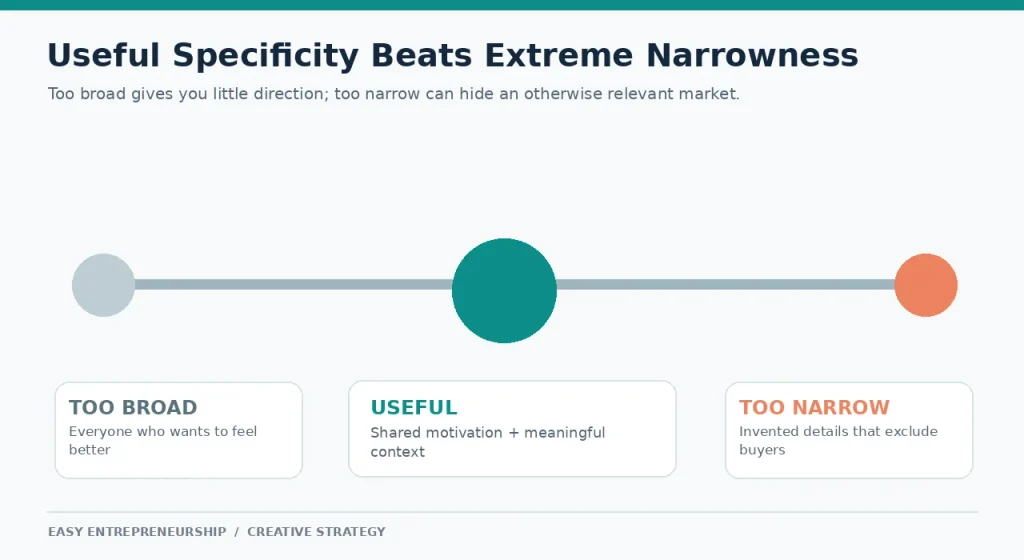
The easiest mistake in customer research is going from a broad market straight to an impossibly narrow person. On one end, “everyone who wants to feel better” gives you no direction. On the other, a 47-year-old in a particular ZIP code with a particular job, a particular pet, and a dozen invented preferences may represent almost no real buyers.
The goal is not maximum detail. It is useful specificity. Add a detail because it changes the message, not because a persona template has an empty field.
Imagine you sell an easy-clean pet grooming brush. Your core avatar might be “people who want to remove loose pet hair more easily.” A first sub-avatar could be “people who have tried brushes that are hard to clean.” Another could be “owners who groom their pets after every walk and want a faster cleanup.” Those are two distinct creative directions built around the same product.
Notice what we haven’t done: guessed their political preferences, invented household incomes, or decided they all live in the suburbs. None of those assumptions is necessary to write the first ad. Research may later reveal a relevant demographic pattern, but the message does not need to wait for it.
There is a healthy tension between broad reach and relatable copy. The broader your message, the more people may recognize the desire, but the harder it can be to stand out. The more specific your message, the easier it may be to sound familiar to the right person, but the fewer people it may resonate with. You need enough market size, not just the sharpest possible description.
Four Realistic Examples: From Generic Audience to Useful Avatar
Let’s turn the framework into examples a small brand or creative freelancer could actually work with. These are hypothetical research sketches. They become working avatars only after you verify them through customer interviews, reviews, sales conversations, or performance data.
Example A: Haircare Brand
Generic persona: Women 45 and older who buy haircare products. Core desire: A routine that feels manageable and helps them care for their hair consistently. Experience: Previously purchased products with complicated instructions. Emotion: Tired of promises that don’t explain realistic use. Behavior: Watches demonstrations and reads ingredient information before trying something new.
A potential ad opening: “Before you add another bottle to your shelf, here’s what a simple routine with this product actually looks like.” The ad would show the real product, explain the steps, and set appropriate expectations. It would not guarantee hair regrowth or imply that the viewer has a medical condition.
This concept is about product clarity, not about making the viewer feel bad about age or appearance. That difference matters. It also gives a video editor a visual checklist: bottle close-up, amount used, application steps, timing, and a straightforward CTA.
Example B: Dog Walking Product
Generic persona: Dog owners in the United States. Core desire: More comfortable walks. Experience: Has tried a leash or harness that did not change the pulling experience. Emotion: Annoyed by the constant struggle. Behavior: Looks for fit demonstrations, sizing guidance, and owner experiences before shopping.
A possible script begins with a real demonstration of the problem rather than a dramatic claim. It might ask, “Trying to find a setup that makes your daily walk easier to manage?” The body can show fit, adjustment, handling, and genuine customer feedback. If the product does not reliably solve pulling, do not claim that it does.
Example C: Bedroom Light-Blocking Product
Generic persona: People interested in sleep. Core desire: A darker room in the early morning. Experience: Tried curtains that left bright gaps at the edges. Emotion: Disappointed by a product that looked promising online. Behavior: Checks installation photos and measures windows carefully.
A relevant creative angle would show the gap problem and a realistic installation process. It could demonstrate how a design addresses edge light—if that benefit is true—rather than making broad claims about curing sleep problems.
Example D: Digital Tool for Freelancers
Generic persona: Freelancers aged 22–45. Core desire: Keep client revisions organized and get work approved with less confusion. Experience: Feedback arrives across email, messaging apps, and video comments. Emotion: Mentally overloaded by version confusion. Behavior: Maintains manual spreadsheets and names files “final-final-v4.”
That last behavior practically writes the hook: “If your client feedback lives in five places, this is the workflow to clean up first.” The rest of the ad can demonstrate the product rather than make empty promises about saving “hundreds of hours.”
Where Do You Find These Insights Without Inventing Them?
A useful avatar doesn’t come from the creative strategist’s imagination. It comes from evidence. The good news is that even a small business has more customer language available than it thinks.
Start with your own material. Read support emails, chat transcripts, returns, product questions, post-purchase surveys, and reviews. Listen to how salespeople describe the questions they hear repeatedly. Pay attention to the difference between what customers ask before purchasing and what they say after receiving the item.
Then look outward. Competitor reviews, public discussion forums, marketplace questions, and social comments can help you identify recurring situations. But keep perspective: a loud complaint is a clue, not evidence that most buyers feel the same way. Public online conversations can overrepresent enthusiastic fans or unhappy customers.
If you can, conduct short interviews with actual buyers. Ask about the moment they decided to look for a solution, the alternatives they considered, what nearly stopped them, and what they wished the product page had explained. Avoid leading questions such as “Were you frustrated by confusing instructions?” Instead ask, “What was confusing, if anything?”
A Seven-Question Customer Research Script
- What was happening when you first started looking for a product like this?
- What were you trying to accomplish, in your own words?
- What had you already tried before finding this option?
- What made those previous options work or fall short?
- Which information helped you feel comfortable buying?
- What nearly stopped you from placing the order?
- What would you tell a friend who is deciding whether this kind of product fits their situation?
Don’t cherry-pick only quotes that support the concept you wanted to make. Collect contradictions too. Sometimes the most useful discovery is that the objection you expected hardly ever appears, while a practical concern—shipping, size, use, compatibility—is mentioned constantly.
Turn Research Notes Into a Usable Avatar Sheet
Raw research gets messy. A spreadsheet full of comments and transcripts can overwhelm a creative team unless someone translates it into a useful brief. I recommend keeping the source material separate from the conclusions you draw.
For each candidate avatar, write a concise summary: the desired outcome, the shared situation, past product experiences, the emotion expressed in customers’ own words, the repeat behavior, the main objection, and the proof that could reasonably address it. Add a column for evidence: review count, interview note, support ticket, or sales observation. Label hypotheses that have not yet been validated.
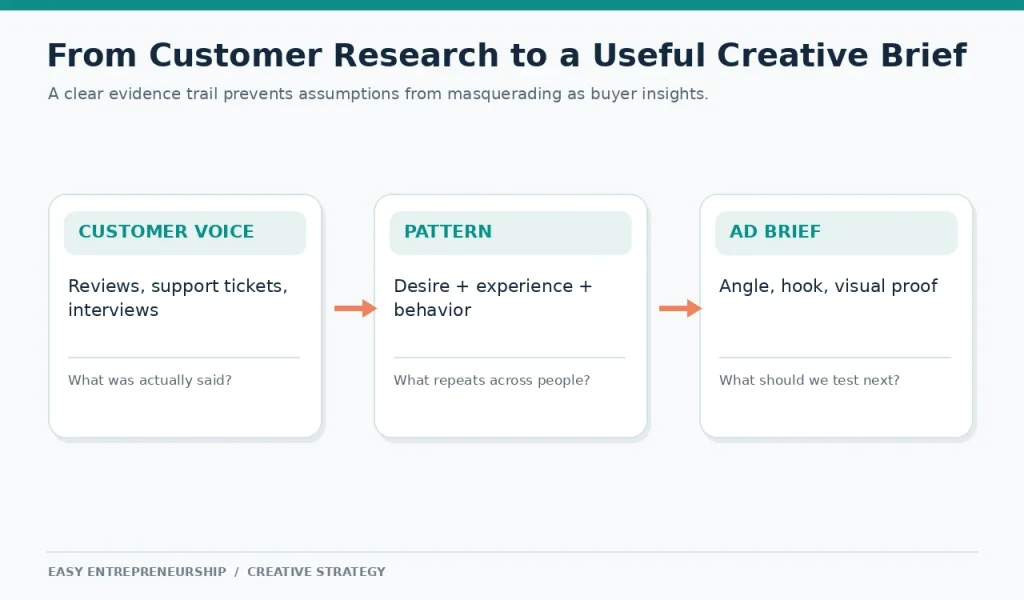
For example, the avatar sheet for a pet grooming tool might say: “Wants easier cleanup after grooming; has purchased brushes that trap hair; often watches cleanup demos; needs to see how the mechanism works.” Under evidence, include the actual customer quotations or references. Under creative direction, write “show the cleanup in one uncut shot, then demonstrate regular use.”
You now have something a strategist can brief, a creator can film, an editor can assemble, and a media buyer can test. That is the difference between research theater and operational research.
What About Beliefs, Values, and Identity?
Beliefs matter. A buyer may believe premium packaging signals better quality, that a familiar ingredient is safer, or that every low-price product will break. But I wouldn’t always create a separate giant persona section called “beliefs” before understanding where those beliefs came from.
Ask three better questions: What experience helped create the belief? How does the person feel about it? What do they now do because they believe it? A customer who says “nothing in this category works” may have tried several products, felt disappointed, and started rejecting ads before watching the demonstration.
That pattern helps you decide what the next creative should show: clear explanation, fair comparison, transparent limitations, or verifiable proof. Merely telling the customer “trust us” probably will not help.
Identity can be relevant too. A person may see themselves as a careful researcher, a practical buyer, or someone who dislikes unnecessary purchases. Speak to that self-image respectfully. Don’t rely on pressure, humiliation, or invented insecurities to force a sale.
How an Avatar Becomes an Ad Angle, Hook, and Video Brief
This is where the whole exercise earns its place in a business. Imagine you found a meaningful cluster of buyers who are interested in a haircare product but skeptical because previous routines felt overly complicated. You could turn that finding into several creative approaches without changing the core product.
Angle one: Routine clarity. Lead with the steps. Show how to use the product, when to use it, and what buyers should realistically expect.
Angle two: Objection handling. Answer the question buyers repeatedly ask in support chats.
Angle three: Founder explanation. Have the founder explain a design choice or ingredient decision, using claims the brand can support.
Angle four: Genuine customer demonstration. Show a real customer using the product with appropriate permissions and disclosures.
Notice that these are different persuasion routes, not four different opening captions. Each calls for different footage and different proof. A good brief should make the difference clear before the editor opens the timeline.
An Example 30-Second Direct-Response Video Brief
Avatar: Buyers who want a simple routine but have been disappointed by complex product instructions. Objective: Reduce confusion and encourage qualified first purchases. Hook (0–4 seconds): “Here’s the routine before you buy.” Body (4–18 seconds): Show the real product, application steps, and any necessary caveats. Proof (18–25 seconds): Include a permitted real-use demonstration or a verified product feature. CTA (25–30 seconds): “See the full routine and product details.”
The actual wording should follow the brand’s product evidence and advertising policies. The benefit of the brief is not that it guarantees performance. It is that the viewer’s question, the ad’s message, and the production plan now line up.
Creative Targeting and Meta Ads: What the Avatar Changes
Marketers sometimes say that creative does all the targeting on Meta now. I understand the point: images, opening lines, topics, offers, and signals from user engagement can affect which people respond to an ad. Still, saying creative accounts for “99% of targeting” is not a documented rule and oversimplifies how ad delivery works.
Audience settings, campaign objectives, conversion data, geography, optimization events, budgets, and Meta’s delivery systems also matter. Depending on the setup, Advantage+ audience features may allow broader delivery than the interests initially suggested. Your ad does not replace campaign strategy; it works alongside it.
What the avatar does change is the relevance of the message. An ad about untangling a complicated morning routine gives a person with that specific problem a reason to pay attention. An ad explaining fit and setup may attract someone who has already tried a similar product. A generic “best quality, shop now” message offers less context.
Meta Blueprint has published training on creative diversification—varying concepts, motivators, and formats so advertising can reach people with different reasons to respond. That is consistent with using research-informed avatars to develop distinct ideas, but it does not mean every niche creative automatically lowers CPA. Only measurement can establish that in your account.
The Difference Between Avatar Testing and Hook Testing
Once you understand your buyers, it is tempting to change everything at once: avatar, voiceover, creator, music, offer, landing page, and CTA. The resulting ad may perform better, but you will have no clear idea why.
Avatar testing asks a bigger question: Which buyer motivation or situation should the ad address? Hook testing asks a narrower one: Which opening communicates the same core idea most effectively? Those are different test layers, and your naming and reporting should reflect the difference.
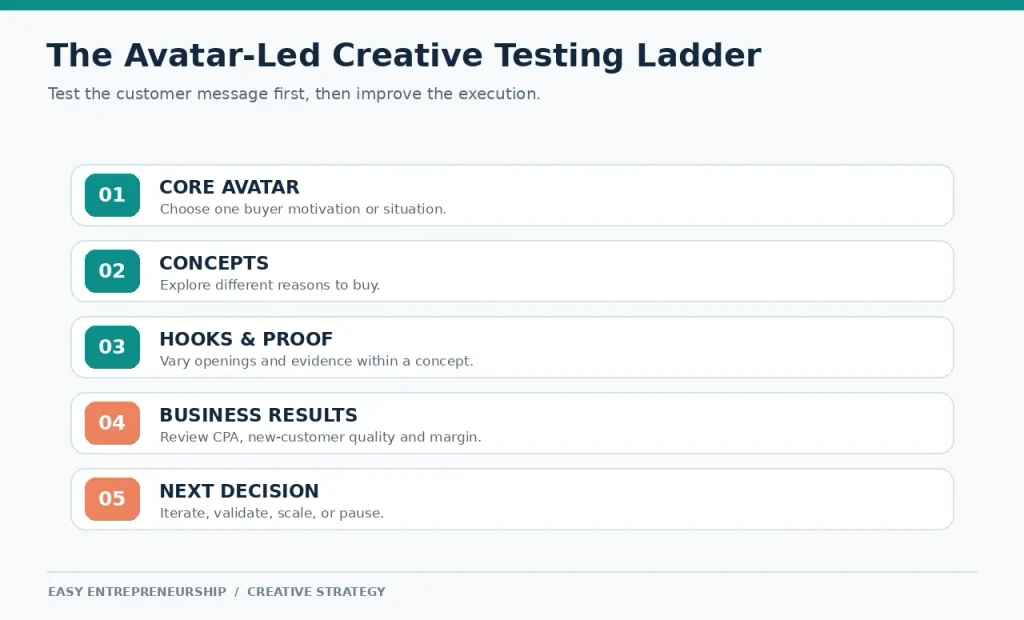
A practical sequence is to explore two or three distinct avatar-led concepts. If you’re new to testing different advertising concepts, I recommend reading my guide on Creative Testing Framework for Meta Ads, where I explain how creative strategists and media buyers test, analyze, and scale winning ads. When one shows promising acquisition quality, keep its central message and test hook variations, proof treatments, or video formats. If the test budget is small, don’t label tiny differences as definitive. Uneven delivery inside one ad set also is not the same as a randomized A/B test.
The media buyer should agree with the strategist on the primary business metric before production. For ecommerce, that may be first-purchase CPA, new-customer CPA, or contribution-adjusted acquisition cost. CTR and video hold rate can help diagnose the journey, but they shouldn’t replace sales quality as the decision criterion.
A Small Illustrative Test Plan
Suppose a haircare store has room to explore three concepts: “simple routine,” “ingredient explanation,” and “common objection answered.” Each concept receives its own tracking label, a documented creative brief, and a fair opportunity for delivery that the media buyer can afford. The team agrees to keep the offer and landing page constant where possible.
After the test, the team asks: Did one message bring more qualified first-time customers? Did another produce clicks but fewer purchases? Was a landing-page problem common to all three? What did the evidence reveal that changes the next brief? Avoid inventing ROAS targets from industry averages without knowing the brand’s margin and economics.
Your Creative Testing Log Should Capture the Learning
I like a short log that records the avatar hypothesis, concept, hook, format, spend, primary conversion result, secondary metrics, and the decision. A useful line might read: “Routine-clarity video produced more product-page visits but no clear CPA improvement; simplify the landing-page instructions before another creative variant.”
That is much more valuable than “UGC won” or “video three lost.” Even a concept that underperforms can tell you which objection remains unresolved or what proof the audience still needs. The next campaign should start from what you learned rather than from guesswork.
How Many Customer Avatars Should a Brand Have?
There isn’t a universal number. The right answer depends on the product, revenue, team capacity, customer diversity, and ability to test ideas properly. A small brand generally gains more from understanding one strong buying motivation deeply than from maintaining twelve shallow persona documents.
My preferred starting point for a lean business is one core avatar with two or three carefully researched sub-avatars. Run a few meaningful creative experiments, learn what is true, and expand only when there is evidence that another motivation deserves attention.
For a brand with a larger creative team and a proven offer, more core avatars may make sense. Different product uses, shopping occasions, or buying motivations can support separate concepts. However, scaling does not mean collecting persona cards. It means maintaining the research, content production, measurement, and operational discipline needed to serve more people without losing message quality.
Revenue thresholds sometimes appear in marketing training as a shortcut for deciding how many avatars to manage. Treat those as heuristics, not laws. A subscription brand with one clear use case may need fewer avatars than a smaller brand whose product serves several unrelated needs. Team focus matters more than a particular dollar milestone.
What Video Editors Can Learn From Avatar Research
A video editor who understands the customer can make better choices before cutting a single frame. If the avatar is concerned about setup complexity, the first shot probably shouldn’t be a dramatic product beauty montage. A close-up of an actual application step may answer the real question sooner.
Similarly, pacing should match the job the creative needs to do. An unfamiliar product may require more explanation. A known product with an obvious use case may need quick proof and a clear offer. People comparing alternatives may want an honest side-by-side demonstration, not just more animated captions.
You can turn the avatar sheet into a shot list: the moment of frustration, the actual use scenario, the critical demonstration, a credibility cue, and the next action. Include captions that reflect customer language without pretending to quote someone who never said it. Label files by avatar, angle, hook, and version so the performance team can trace what it tested.
For freelancers, this helps you move from “I edit video ads” to “I edit against a buyer problem and a test hypothesis.” The work still needs craft. But now the craft has a reason.
What Business Owners Should Do Before Spending More on Ads
If your ads are getting clicks but the store is not converting, the problem may not be the avatar. It may be the price, the offer, slow loading, hidden shipping fees, unclear product information, weak proof, or a checkout problem. Good customer research is not a substitute for a functioning buying experience.
Before ordering another batch of creative, read the product-page questions, review the checkout funnel, and check whether the ad’s promise is consistent with the landing page. A creative that says “a simple two-step routine” should not lead to a page that requires ten minutes of digging to find instructions.
Start with a modest research loop. Speak to a few customers, review support patterns, identify one repeated purchase barrier, write two genuinely different concepts, and measure what happens. You do not need a massive brand department to act on better customer understanding.
Avoid These Seven Common Avatar Mistakes
Mistake 1: Starting and ending with demographics. Age and location may matter, but they rarely reveal the immediate purchase motivation.
Mistake 2: Inventing emotions. Use customer language and mark unverified assumptions.
Mistake 3: Confusing product disappointment with product desire. “Tried a brush that trapped hair” is an experience; “wants easier cleanup” is the desire.
Mistake 4: Combining five unrelated desires into one persona. That often produces a weak, unfocused creative brief.
Mistake 5: Getting so specific that the message excludes otherwise relevant buyers. Details should earn their place.
Mistake 6: Using avatar descriptions as sensitive personal-attribute callouts. Don’t imply you know a viewer’s private condition or hardship.
Mistake 7: Never updating the avatar. Real customer feedback and performance results should revise your assumptions over time.
There is one more quiet mistake: treating an avatar as a replacement for product truth. You cannot copy your audience’s pain points into a script and expect an unsuitable product to become a good purchase. Good strategy makes real value easier to recognize; it doesn’t manufacture value that isn’t there.
A 30-Minute Customer Avatar Workshop for a Small Team
You can run a useful first workshop without a consultant or a complicated slide deck. Gather recent reviews, support questions, product-page feedback, and any interviews you have. Invite the person who edits the ads and the person who buys the media, not only the founder.
Spend five minutes choosing one product and one business goal. Spend ten minutes sorting actual customer statements into desires, experiences, emotions, behaviors, and relevant demographic facts. Spend five minutes identifying the strongest repeated pattern, then five minutes drafting a core avatar and one sub-avatar. Use the final five minutes to define a creative hypothesis and assign who will check it against more evidence.
The output should fit on one page. Write what you know, what you suspect, and what you need to test. If the team leaves with a clear opening line, a short proof list, and a measurable question, the workshop was useful. If it leaves with a beautiful slide deck and no next action, try again.
Copyable Ecommerce Customer Avatar Template
Use the following template in a creative tracker, Google Doc, or shared brief. Keep answers short and make a distinction between evidence and interpretation.
| Field | Question to answer |
| Product and offer | What are we actually selling, and under which terms? |
| Core desire | What outcome does this buyer want? |
| Situation | What is happening in their life or routine? |
| Previous experience | What have they already tried or bought? |
| Expressed emotion | How did the buyer describe the experience? |
| Repeated behavior | What do they do before they decide? |
| Main objection | What could stop a purchase? |
| Belief to address | What needs clarification or evidence? |
| Useful demographic | Which factual detail changes product fit? |
| Proof available | What can we show honestly? |
| Creative angle | What one message should the next ad test? |
| Primary metric | How will we evaluate business value? |
| Evidence source | Where did the insight come from? |
| Confidence | Confirmed, plausible, or untested? |
A sample filled-in version might say: “Core desire: easier grooming cleanup. Experience: current brush traps loose hair. Behavior: watches cleanup demos and checks negative reviews. Objection: unsure the new brush will be easier to maintain. Proof: real one-take cleanup footage. Creative test: demo-first video versus product-overview video. Primary metric: first-purchase CPA.” That is a workable production brief, not just a fictional profile.
Frequently Asked Questions About Ecommerce Customer Avatars
Is a customer avatar the same as a buyer persona?
In many marketing teams the terms overlap. Both describe a relevant customer group. In practice, an avatar is often used to guide messaging and creative production, while a more formal persona may include wider journey, product, or user-experience research. Define the purpose rather than arguing about labels.
Is an ICP the same as an ecommerce customer avatar?
Not always. In B2B, an ideal customer profile frequently describes the type of company most likely to be a good fit. In DTC ecommerce, avatar and buyer persona usually focus more directly on the individual buyer’s motivation and situation. Some teams use ICP loosely across both settings.
Should an avatar include age and gender?
Only when those characteristics materially affect product fit, accessibility, language, creative context, or lawful targeting. Do not assume demographics explain desire. Research what actually matters for the purchase.
How many avatars should I create for one product?
Start with one meaningful core motivation and a small number of validated sub-avatars. Expand when your research and testing capacity justify it. The right number is a management decision, not a magic number.
Can customer avatars improve Facebook and Instagram ads?
They can help you create messages that are more relevant to real motivations, which may improve performance. But an avatar does not guarantee lower costs. Campaign optimization, product-market fit, offers, landing pages, and measurement remain important. Test the idea and judge business outcomes.
What is the difference between a core avatar and a sub-avatar?
A core avatar describes a shared outcome or situation, such as wanting easier home workouts. A sub-avatar adds a relevant experience or behavior, such as people who currently exercise at home because they cannot reliably reach a gym. The additional detail should lead to a useful difference in messaging.
Can I create avatars using AI tools?
AI can help organize research notes, identify themes, and draft hypotheses. But it can also invent quotes, exaggerate patterns, and produce confident-sounding stereotypes. Use original customer evidence, review the outputs, and keep unsupported guesses clearly labeled.
How does a video editor use an avatar in practice?
The editor uses it to choose the opening scene, product proof, pacing, captions, and CTA appropriate to the buyer’s question. For example, a skeptical buyer who has tried alternatives may need a direct demonstration before a polished brand montage.
How do I know if my customer avatar is wrong?
Watch for contradictions. Customers may not mention the objection you expected. Your new creative might bring plenty of clicks but weak purchase quality. Interviews may uncover a different primary need. Treat the avatar as a working hypothesis that can change, not as a permanent truth.
Final Thought: Know the Person Behind the Purchase
There is a reason some ads feel uncannily relevant while others disappear into the feed. Often, the relevant one starts with a clearer understanding of the customer’s actual situation. It doesn’t need to shout louder. It needs to answer a question the person already has.
For a business owner, that understanding can prevent wasted production and help surface real product objections. For a creative strategist, it turns research into a testable message. For a video editor, it informs the footage and pacing. And for a media buyer, it creates a more meaningful creative pipeline to evaluate.
The point isn’t to build the most elaborate persona in the industry. It is to build one you will use, verify, and improve. Start with what people want. Listen to what they have experienced. Notice the feelings and habits attached to those experiences. Add demographic details when they truly matter. Then turn the learning into one better ad—and see what the market tells you next.
Author
Shajib Sutradhar
Creative Strategist • AI Content Creator
I am a professional digital marketer with over 6 years of experience working with international clients on Upwork. Alongside client services, I build passive income platforms and scalable AI advertising workflows. Through my official website Easypreneurship.com and my YouTube channel AI Creative Lab Studio (@AICreativeLabStudioAI), my mission is to provide practical, fluff-free tutorials and strategies for freelancers, e-commerce owners, and students looking to build sustainable digital careers.
🚀 Try Higgsfield AI for Professional Ad Creation
Founder of Easypreneurship.com
📱 WhatsApp: +8801715163076
Sources and Further Reading
Meta Blueprint: Increase Campaign Performance with Diversified Creative — official training on varying concepts, motivators, and formats.
Meta Blueprint: Ad Creative That Converts — creative diversification and production approaches.
FTC: Endorsements and Testimonials in Advertising — truthfulness and disclosure considerations.
FTC: Consumer Reviews and Testimonials Rule Q&A — practical guidance on fake or misleading testimonials.
Google Search Central: Creating Helpful, Reliable, People-First Content — guidance on original, useful publishing.