By Shajib Sutradhar · Easypreneurship · Updated November 2026
For DTC founders, U.S. marketing teams, agency owners, creative strategists, media buyers, and video editors who want ads to do more than attract views.
Imagine you have spent an afternoon editing a product video. The footage looks sharp. The captions are readable. The music lands on the cuts. Your client likes the final export, and everyone is ready to launch it.
However, a few days later, the campaign report is disappointing. People barely watch, and the clicks that do come through are not turning into customers.
Naturally, the first reaction is to revisit the edit. Perhaps it needs faster cuts, a brighter first frame, or a more dramatic opening. Those changes can be useful. But there is another question worth asking before you touch the timeline: Why would the right customer care about what happens in the first place?
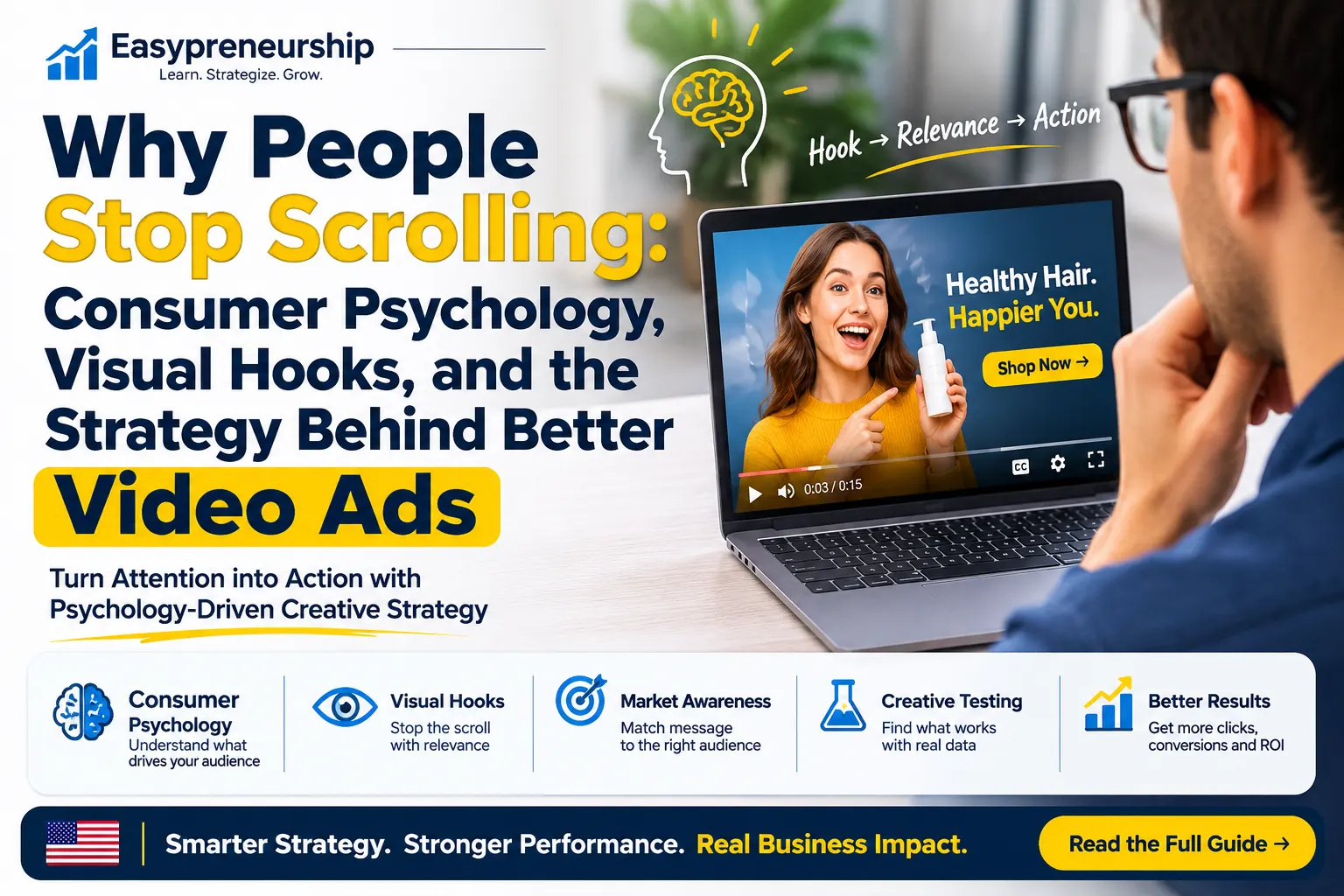
In practice, that question connects consumer psychology to the craft of video editing. A visual hook is not just an effect that interrupts a feed. It is the first part of a promise the rest of the advertisement must keep.
In this guide, we will look at 15 video ad hooks, the psychological ideas behind them, and the practical decisions that turn a short attention-grabbing moment into a more useful advertising message. We will also discuss market awareness, hook rate, hold rate, testing, AI production, and what small businesses should do when they cannot afford endless creative experiments.
None of the hooks below guarantees results. The examples are illustrative, not claims about a particular client’s campaign. Their value comes from giving you better questions to test.
1. The Real Problem Is Not Always a Short Attention Span
It is tempting to blame a weak video on shrinking attention spans. But the same person who skips a 20-second advertisement might watch a 40-minute product review, follow an entire cooking tutorial, or read a long discussion about something that matters to them.
In fact, people do pay attention. They are selective about what earns it.
Think about someone scrolling through Instagram after work. They may be looking for entertainment or checking on friends. They did not open the app to hear your product pitch. Your ad appears between things they chose to see, and the first frame must compete with that context.
Consider two openings for a haircare product. One shows a perfectly lit bottle rotating against a dark background. The other shows a woman looking at her hair in a bathroom mirror and saying, “I thought the dryness was just part of getting older.”
Which performs better? We cannot know without a test. For example, the first might work well for people already familiar with the product. The second could resonate with someone who recognizes that experience. The useful lesson is not that product shots are bad or that mirror selfies always win. It is that relevance changes the job of the first few seconds.
For a U.S. DTC founder, this matters because a visually impressive production can still be poorly matched to the intended buyer. For an agency, it means a creative review should begin with the audience and the offer, not just an editing checklist.
2. A Strong Video Hook Has Three Jobs
In practice, the opening of an ad usually has to do three things in a very short space: interrupt the automatic scroll, signal relevance, and give the viewer a reason to continue.
Attention: Something makes a person notice the video. A sudden spill, a question, a familiar notification, or a striking close-up can do this.
Relevance: The viewer recognizes a problem, desire, situation, or decision that matters to them. This is what separates an entertaining interruption from an advertising idea.
Progression: The video makes a useful promise about what comes next. The viewer expects an answer, demonstration, comparison, or credible result.
However, a surprising visual without relevance often produces curiosity without purchase intent. Relevance without a clear opening may never get noticed. And a great opening followed by a slow, confusing explanation can lose the attention it earned.
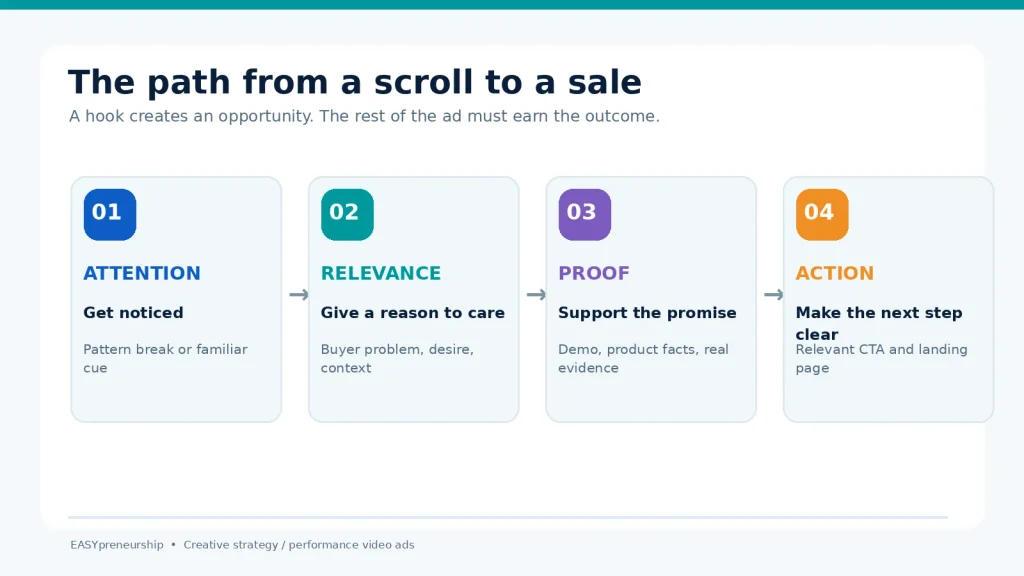
A useful way to judge an opening is to ask: If I removed the music and motion graphics, would the underlying idea still matter to my customer? If the answer is no, you may be polishing a distraction.
3. Pattern Interrupt: What Makes a Visual Different Enough to Notice?
A pattern interrupt happens when something breaks the sequence a person expects. In a feed full of talking-head clips, that might be an unexpected object. In a feed full of elaborate edits, it might be a plain spoken sentence on a quiet background.
Importantly, the technique does not need to be loud. The interruption only needs to be noticeable in context.
For example, imagine an ad for stain remover opening with hot coffee falling onto a white shirt. The moment is sudden, but it also introduces the product problem. The viewer immediately understands why the next few seconds might be useful.
Now imagine the same spill being used to open an ad for accounting software, with no explanation. It might produce a brief pause. But unless the story connects the spill to a financial problem, the viewer may remember the chaos and forget what was being sold.
This is the distinction marketers sometimes miss: a pattern interrupt can win the first second while losing the next ten.
Before using one, write down what the unexpected moment communicates. Does it introduce the problem? Demonstrate a benefit? Show a meaningful contrast? If you cannot connect it to the offer in a sentence, rethink the opening.
When to use a pattern interrupt
It often makes sense when a product has a visible use case: cleaning, kitchen tools, footwear, organization, home maintenance, or physical demonstrations. In more complex categories such as B2B software, an unexpected visual still needs quick context so the audience understands the connection.
4. Cognitive Fluency: Familiar Can Be More Effective Than Flashy
Not every scroll-stopping ad needs a surprise. Sometimes the familiar is easier to understand.
Cognitive fluency refers to the ease with which people process information. Search bars, text messages, social comments, incoming-call screens, and ordinary phone recordings are recognizable formats. Viewers often understand their basic structure without an explanation.
For instance, a skincare ad could open with a search bar containing the question: “Why does my skin still feel dry after moisturizing?” The format is familiar, and the question may reflect a real customer concern. That combination can make the opening easier to process.
Still, a search bar is not automatically persuasive. If the question has nothing to do with the intended buyer, familiarity will not rescue it. Nor should a designed chat screen impersonate a real customer’s private message or independent review.
For editors, cognitive fluency offers a practical creative choice: use a familiar visual language when it helps the audience understand the message faster. A screenshot-inspired design can work with modest production resources, which is useful for small brands testing multiple ideas.
5. The Curiosity Gap: Why Viewers Want to See the Next Frame
Curiosity begins when someone notices a gap between what they know and what they want to know. In video ads, you can create that gap by withholding a comparison, delaying a reveal, or asking a question that the demonstration will answer.
Picture two similar-looking work shoes side by side. One has a simple red X above it, and the other has a green check. A caption asks, “What is the difference?” For someone comparing comfort or design features, that question may give them a reason to watch.
What matters, however, is what happens next. If the video quickly explains a real, verifiable distinction, the curiosity has served the message. If it drags out the reveal for 25 seconds and delivers something unrelated, the hook has become clickbait.
An open loop is a storytelling device that introduces an unanswered question and resolves it later. It is useful when the answer is worth the wait, not when the goal is to keep viewers confused.
For example, “There is one reason your video ads lose viewers before the product appears” is only a good opening if the ad then identifies and explains that reason. Curiosity should create anticipation and reward it.
6. Market Awareness: The Same Hook Will Not Work for Everyone
For example, hooks can underperform is that they assume every viewer knows the same things. But a shopper who has never considered a problem is in a different situation from someone comparing two specific products.
The five levels of market awareness, discussed by Eugene Schwartz in Breakthrough Advertising, are a helpful planning lens. They are not five rigid boxes that every person moves through in exactly the same way. Rather, they remind us to match information to what buyers already understand.
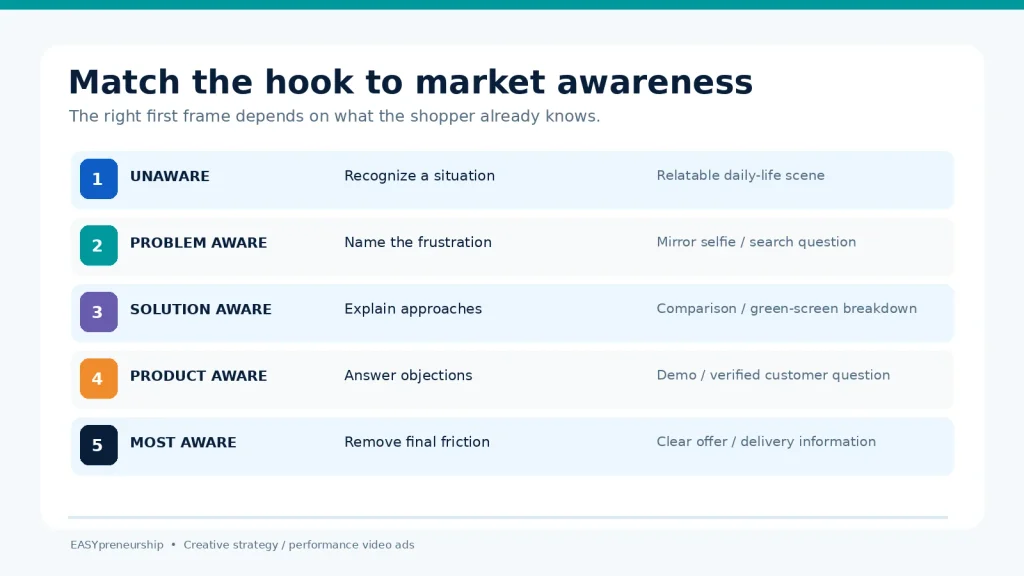
Unaware: start with a recognizable situation
Someone may stand for long shifts without thinking much about footwear design. A discount on a shoe will not necessarily feel relevant. An opening showing tired feet after a workday might introduce a situation they recognize. The product can come later, once the story establishes why the topic matters.
Problem-aware: show that you understand the frustration
A person knows their hair feels dry, but they are unsure why. A mirror-selfie hook or a search question such as “Why does my hair still feel dry after conditioning?” may work because the audience already recognizes the issue. The ad does not need to invent a problem; it needs to clarify it.
Solution-aware: explain the available approaches
A shopper may know that there are different ways to address their concern. They may want a demonstration, a comparison, or a simple explanation of features. A green-screen breakdown or side-by-side visual can support this research stage.
Product-aware: answer objections and show proof
This person knows your product exists. Their question is no longer simply “What is this?” It may be “Is it right for my needs?” or “How does it compare with the alternative?” A verified customer question, an authentic demonstration, or clear product information can be more useful than a mysterious opening.
Most-aware: reduce the friction to act
A person who already understands the product may be waiting for price, delivery details, a relevant bundle, or a clear purchase path. In that situation, a straightforward offer can beat a complicated curiosity sequence. You do not need to re-educate someone who is ready to decide.
Ultimately, the key is not to assign every visitor a perfect label. It is to ask what the audience already knows and still needs to believe before taking the next step. For a deeper explanation, read our market awareness guide.
7. Fifteen Visual Hooks Worth Understanding — Not Just Copying
Hook lists become dangerous when people treat them like guaranteed formulas. The more helpful approach is to understand the communication job behind each one. Below are 15 visual techniques grouped by the way they can attract or guide attention.
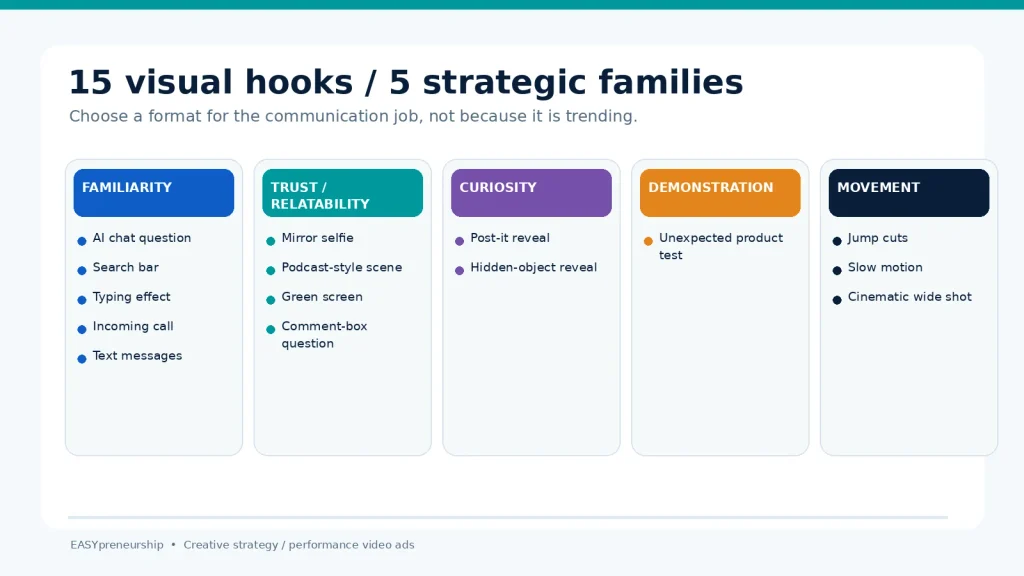
Familiarity-based hooks
1. AI chat-style question. Start with a clear question in a familiar chat interface, then move quickly into a real explanation. A cleaning product might use an on-screen question about removing a stubborn household stain. The design should not imply that an AI system independently verified your product unless that is true.
2. Search bar. Type a question that resembles the language customers use when researching a problem. For a home organization product, “How do I make a tiny closet feel bigger?” gives the viewer a recognizable task. Good research makes the question specific without becoming awkwardly long.
3. Typing effect. Reveal a short sentence as if it is being typed in real time. This can add pacing to a question or a customer observation. Keep it brief: if the text takes too long to appear, the effect becomes an obstacle rather than a hook.
Notification and Conversation Hooks
4. Incoming call. Use the visual of a phone ringing or a call being answered to create immediate movement and context. A service business might open with “Another last-minute appointment cancellation?” The call visual should lead directly to the relevant business problem, not just function as a random notification.
5. Text-message conversation. Show a short, readable exchange that introduces a common customer situation. It can help explain a product through informal language. If the messages are scripted, present them as a dramatization rather than pretending they are verified private customer messages.
Relatability and trust hooks
6. Mirror selfie. A person filming themselves in an ordinary setting can make a story feel personal. For haircare, a bathroom mirror may be more contextually useful than a studio product shot. This is a format choice, not proof that the person had a particular experience.
7. Podcast-style discussion. Two speakers or a solo host in a podcast-like environment can introduce a question and a clear explanation. The benefit comes from a conversational pace and useful context, not from pretending a staged promotional video is independent journalism.
8. Green-screen breakdown. A creator appears in front of an image, webpage, comparison chart, or product demonstration. This works well when a buyer needs to understand a complicated point quickly. Make sure the evidence on screen is accurate and legible on a phone.
9. Comment-box question. A real, permissioned customer question can provide a natural starting point: “Will this fit a small apartment?” The response can become a product demo. Do not invent a comment and pass it off as genuine social proof.
Curiosity and reveal hooks
10. Post-it note reveal. Use physical notes or simple overlays to reveal “Problem,” “Cause,” and “Solution” one at a time. This works particularly well for tutorials and service explanations because the structure organizes the viewer’s thinking.
11. Hidden-object curiosity. Show two objects, cover a meaningful detail, or ask the viewer to notice a difference. The next frames must supply an answer connected to the product. Without that payoff, it is merely a visual puzzle.
Demonstration and surprise hooks
12. Unexpected product demonstration. Begin with an authentic test or a visible problem that the product is designed to address. A coffee stain on white fabric is easy to understand. Editing should not manipulate the test to imply results the product cannot reliably deliver.
Movement and sensory hooks
13. Jump cuts. Remove pauses and compress a sequence of actions: opening, applying, using, and checking a product. This can make a demonstration easier to follow. Too many jumps, however, may hide important details or make the message tiring.
14. Slow-motion detail. Slow down a moment that benefits from close observation, such as fabric texture, water movement, or the way an object opens. The technique supports sensory understanding but rarely communicates a complete offer on its own.
15. Cinematic wide shot. Establish a setting in which a product belongs—a clean workspace, a busy kitchen, or an outdoor trail. A wide shot can supply atmosphere and context, especially for lifestyle brands. It still needs a clear connection to the audience’s reason to buy.
Notice that these 15 options do not all solve the same problem. A search bar surfaces a question. A product demonstration provides evidence. A mirror selfie introduces a relatable situation. A wide shot creates context. Choosing among them is a strategic decision, not simply a style preference.
8. Why the Hook Cannot Carry the Whole Advertisement
Some creative discussions treat the first three seconds as if everything else is secondary. The beginning matters, but it only sets expectations.
Imagine an ad with a strong opening: a woman notices dry hair in a bathroom mirror. The video gets her attention. Then the narration spends 20 seconds repeating that dry hair is frustrating, with no explanation, product benefit, or credible evidence. The opening did its job, but the message went nowhere.
Instead, a more useful flow connects the opening to the rest of the story:
Hook → Problem or desire → Product explanation → Proof → Call to action.
For a 30-second haircare ad, the hook could introduce a familiar moment; the next section explains the problem without exaggerated claims; the product is demonstrated in normal use; verified proof supports the stated benefit; and the final frame gives the buyer one clear action.
Therefore, the timing of those sections should change with market awareness. A most-aware shopper may need almost no problem explanation. A new audience may need more context. This is what marketers mean when they talk about message-market match: the ad answers the questions a particular audience actually has.
One practical editing test is to watch the video with the sound off. Can viewers still understand the problem, the product, and the action? Then listen without looking. Does the narration tell a coherent story? These checks will not predict performance, but they can uncover basic communication problems before launch.
9. Hook Rate, Hold Rate, CTR, and CPA: Read the Whole Funnel
Once an ad is live, creative opinions should be tested against performance evidence. The challenge is deciding which metric answers which question.
Hook rate is a team-defined early-viewing metric. Some teams calculate three-second views divided by impressions. Others use a different denominator or platform-specific measure. Agree on the definition before comparing campaigns.
Hold rate measures how well viewing continues beyond the initial opening. Again, there is no single calculation used in every reporting dashboard. For example, a high hook rate with a weak hold rate can suggest that the beginning creates expectations the body fails to satisfy.
From Video Engagement to Business Results
Click-through rate (CTR) tells you how often impressions lead to a specified click. Link CTR and outbound CTR are not necessarily identical, so check the reporting column.
Conversion Metrics: CVR, CPA, and ROAS
Conversion rate (CVR) connects visits or another defined starting event to a business action, such as a purchase or lead. Cost per acquisition (CPA) measures spend per acquisition. Return on ad spend (ROAS) compares attributed revenue with advertising spend, but it does not account for every cost of running a business.
| Metric | What it helps you understand | What it cannot prove alone |
| Hook rate | Did viewers stay through the opening? | Whether they wanted the product |
| Hold rate | Did the body keep attention? | Whether the audience was qualified |
| Outbound CTR | Did people click through? | Whether clicks were profitable |
| Landing-page CVR | Did the page convert visitors? | Whether orders had healthy margins |
| CPA / qualified lead cost | What did an outcome cost? | Long-term customer value |
| ROAS | Attributed revenue relative to spend | Actual net profit |
Instead, think of these as diagnostic instruments, not competing trophies. An ad with fewer views but qualified purchases may be far more valuable than one with a viral opening. Conversely, if an ad has weak attention metrics, it may deserve a creative revision before the team blames the landing page.
For media buyers, the useful habit is to connect every creative decision to a specific outcome: attention quality, traffic quality, conversion efficiency, or customer economics.
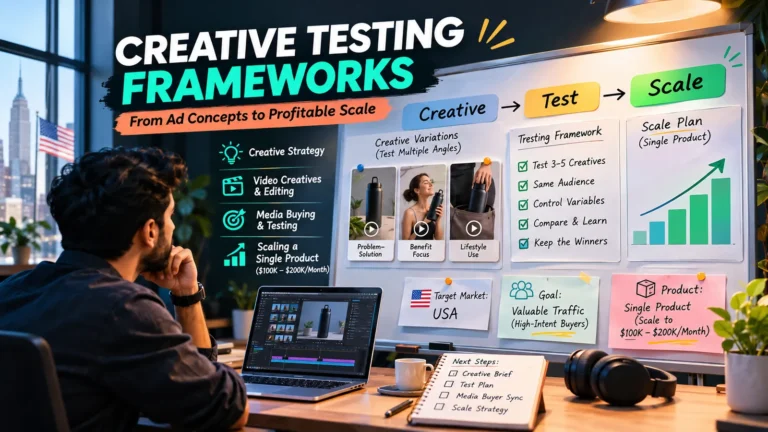
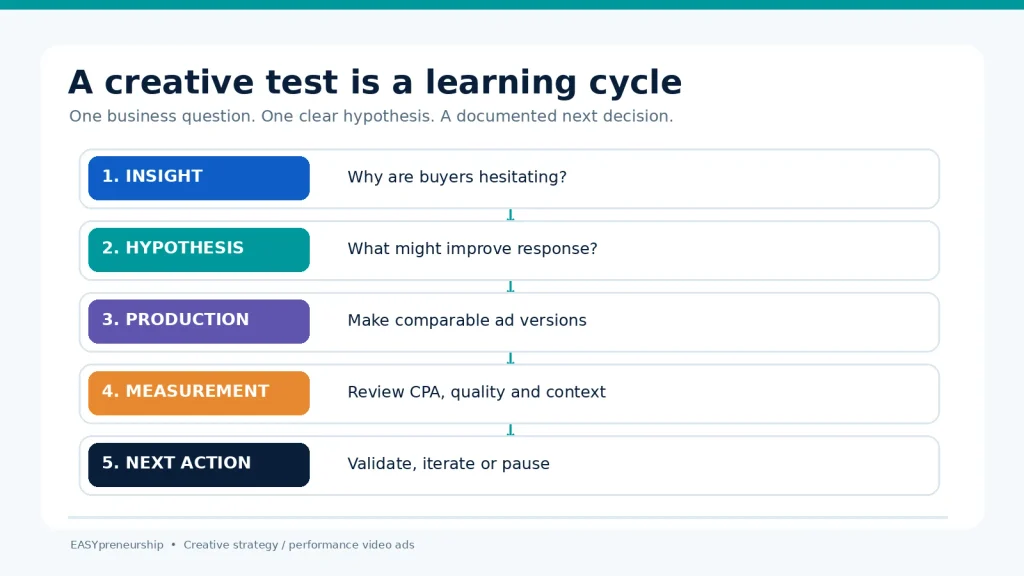
10. A Practical Creative Test for a Single DTC Product
Suppose you sell one home-cleaning product and want to test three different opening ideas. Instead of changing music, captions, talent, offer, landing page, and story all at once, start with three clear hypotheses.
Concept A — Relatable problem: A coffee spill introduces the situation. Hypothesis: showing an immediate problem will attract buyers who recognize the need.
Concept B — Search intent: A search bar types “How do I remove coffee stains from white fabric?” Hypothesis: a familiar customer question will connect with people actively researching a solution.
Concept C — Product demonstration: The first frame shows a genuine, fair demonstration. Hypothesis: visible proof will create more qualified traffic than a problem-led opening.
For a clearer comparison, hold the offer, landing page, reporting window, and as much of the body as practical consistent. That does not isolate every variable perfectly, but it makes the experiment more interpretable. For more rigorous comparisons, consider a properly structured A/B test instead of assuming that three ads in the same ad set received equal exposure.
Example results (illustrative, not actual client data)
| Opening concept | Spend | Outbound CTR | Purchase CPA | Interpretation |
| Relatable problem | $450 | 2.1% | $30 | Worth reviewing the body and landing-page fit |
| Search-bar question | $450 | 3.8% | $45 | Strong clicks; weaker purchase economics |
| Genuine demonstration | $450 | 1.9% | $25 | Lower click rate; better reported acquisition cost |
If the target CPA is $28, the demonstration concept is the most promising candidate in this small example. But $450 per ad is not enough to declare a permanent winner. We would check attribution, conversion quality, sample size, differences in delivery, and whether performance holds with additional spend.
The useful next question is not simply “Which video won?” It is “What did we learn about what this audience needs to see before buying?”
If the search-bar creative generates cheap clicks but expensive purchases, it may be attracting research-stage shoppers. That suggests testing a more educational landing page, a follow-up message, or a different offer—not necessarily abandoning search-bar openings forever.
Document one short note for each test: hypothesis, variation, audience and offer, budget, primary metric, result, limitations, and next action. Over time, that log becomes a more useful resource than a folder called “Winning Ads.”
11. Creative Fatigue: Why Copying Popular Hooks Is Not a Strategy
Visual trends move quickly. A staged podcast scene may be novel when a few brands use it, then lose some of its novelty when it appears everywhere. The same can happen to dramatic captions, fast zooms, and oversized notification graphics.
However, that does not make the format automatically ineffective. It changes the context in which the format is seen.
Creative fatigue is often used to describe a decline in response when people repeatedly see the same or similar advertising. But weak results can have other causes too: changing demand, greater competition, a weaker offer, or differences in the audience reached. Do not diagnose fatigue from frequency alone.
When planning the next batch, distinguish surface variation from strategic variation. A new transition or voiceover can refresh execution. A different customer insight, benefit, objection, or proof structure tests a deeper idea.
Both types of changes have a place. The mistake is calling ten cosmetic variations ten new strategies.
12. AI Makes Production Easier; It Does Not Choose the Message for You
AI tools can help teams generate B-roll, test layouts, draft scripts, explore visual treatments, and produce multiple versions more efficiently. For a small U.S. business or freelance editor, these capabilities can reduce the cost of exploring an idea.
However, making attractive footage easier does not automatically make the advertisement more relevant. For instance, two editors can use the same video generation tool and produce equally polished work. The difference may be that one begins with a generic instruction such as “make this cinematic,” while the other begins with a documented customer concern, a clear product claim, and a testable creative angle.
By contrast, the second editor has a better reason for every shot. That does not guarantee the ad will outperform the first, but it makes creative decisions easier to explain and improve.
AI can assist with research and production, yet it should not create fake customer comments, invented independent interviews, or demonstrations that imply unsubstantiated results. U.S. advertising claims need to be truthful and supported, and endorsements should not mislead viewers about someone’s real experience or material connection to a brand. The FTC’s endorsement guidance is a useful starting point.
13. A 30-Second Video Ad Brief: From Idea to Editing Timeline
To make the concepts tangible, imagine a fictional U.S. DTC brand selling a fabric-cleaning product. The target shopper is not defined only by age or location. They are someone who wants a quicker, less stressful way to deal with everyday messes and is skeptical of exaggerated before-and-after videos.
Creative objective: Test whether an honest demonstration produces more qualified purchase traffic than a general lifestyle opening.
Audience insight: Customers want to see how the product is used and what it can realistically do on a common stain.
Proposed opening: A coffee spill on a light fabric sample, filmed in one continuous shot.
| Time | Story beat | Editorial direction |
| 0–3 seconds | Visual problem | Coffee spill; simple caption, no fake urgency |
| 3–7 seconds | Context | “Here is how we tested it on this fabric.” |
| 7–17 seconds | Demonstration | Show application and timing honestly |
| 17–24 seconds | Product information | Explain conditions and any important limitations |
| 24–30 seconds | CTA | Clear next step and relevant product page |
In fact, this brief is intentionally ordinary, It does not rely on a celebrity, a dramatic AI avatar, or endless transitions. It gives the audience a problem, a transparent demonstration, and a reason to evaluate the offer.
How to Test and Improve This Creative Brief
Now you can build two controlled opening variations: a search-bar question and a relatable spill story, while retaining the same demonstrated product claim. That is a creative strategy a media buyer can actually test.
For a broader planning approach, connect this work with customer-desire research. Our article on mass desire in advertising explains why different buyers may respond to different outcomes from the same product.
14. What Performance-Focused Video Editors Do Differently
In a traditional workflow, an editor receives footage and a script, then delivers a polished file. That is valuable production work. A performance-focused editor may also ask questions before the timeline opens.
Who is the audience? How aware are they? Which objection does the ad address? Is the first frame introducing the strongest customer reason to care? How will the team recognize a useful result?
Suppose a script begins with an elaborate product animation, but the target buyer is searching for reassurance about fit and usability. An editor who understands the strategy might suggest moving a real demonstration to the first few seconds. Or, if viewers stop watching before the proof appears, the editor might bring the proof forward rather than adding another transition.
Of course, these are not guaranteed performance improvements. They are informed creative decisions that can be proposed, tested, and discussed with the media buyer.
For agencies, this way of working creates a shared language. The strategist identifies the insight. The editor translates it into a visual story. The media buyer evaluates delivery and results. The founder or marketing leader checks whether the acquisition economics make sense.
The goal is not to turn every editor into a full-time media buyer. It is to make production decisions connected to what the business is trying to learn.
15. What a Small Business Can Do This Week
You do not need a large creative department to improve the first seconds of your ads. Start with a single product and three questions drawn from real customer conversations. Review support tickets, sales calls, returns, verified reviews, and questions people ask before they purchase.
Next, choose one question that represents a real objection. Make a short video that answers it with a demonstration or clear explanation. Then create a second opening that introduces the same topic through a familiar search or comment format. Keep the body and offer as consistent as possible.
If your ad budget is small, treat early results as directional. You can also learn from organic content and customer interviews, while remembering that organic engagement is not equivalent to purchase performance in paid campaigns.
Above all, write down what you expected, what happened, and what you will change next. That practice makes each creative more useful even when it does not become a winner.
Frequently Asked Questions About Video Ad Hooks
What is a video ad hook?
A video ad hook is the opening idea, image, statement, or sequence designed to earn attention and introduce the message. It is effective when it attracts relevant viewers and connects naturally to the rest of the ad.
How long should a video ad hook be?
There is no single required length. Many short-form teams focus on the first one to three seconds because those moments are easy to lose, but the right opening depends on platform, audience, format, and message. Avoid turning a useful explanation into an arbitrary three-second rule.
Which video hook works best for Meta Ads?
No hook is universally best. A product-aware audience may respond to a demonstration, while a problem-aware audience may respond to a relatable scene or search question. The answer has to come from testing with the right business metric.
What is the difference between hook rate and hold rate?
Hook rate is commonly used to describe early-viewing engagement; hold rate describes continued viewing after the opening. Definitions vary, so compare creatives only after agreeing on consistent calculations and reporting conditions.
Can visual hooks increase sales?
They can help a relevant message earn attention, which may support sales. But a hook alone cannot fix a weak product, an unconvincing offer, a confusing website, or unprofitable customer acquisition. Evaluate the complete path to conversion.
Should editors use AI-generated visual hooks?
AI can help produce useful visuals if the final message is accurate and appropriately disclosed where necessary. Do not create fabricated testimonials, fake customer conversations presented as real, or misleading product demonstrations.
How many hooks should I test at once?
Test volume should fit the budget, expected conversions, and the specific question. A small business may learn more from two clearly differentiated approaches than from ten changes with too little spend to interpret.
Are cinematic ads worse than UGC ads?
Neither format is automatically better. A premium product shot can communicate quality, while a simple creator video can communicate relatable context. Choose the format for the intended buyer and test the outcome rather than accepting a style rule.
Final Thought: Make the First Second Earn the Next One
A phone call can interrupt a scroll. A search bar can introduce a familiar question. A mirror selfie can create a recognizable situation. A demonstration can supply evidence. A slow-motion shot can make a product detail easier to see.
Ultimately, these are tools, not shortcuts to profitability.
Before you ask which effect to use, ask what the viewer already knows, what they want to understand, and what proof they need. That gives the hook a job. The rest of the ad can then keep the promise.
As video production becomes faster and more accessible, the valuable skill is not simply creating more moving images. It is deciding which visual story deserves to be made, for which audience, and how you will know whether it worked.
——————————————
About the author:
Shajib Sutradhar works in performance creative, video advertising, and digital marketing. Through Easypreneurship, he shares practical approaches to creative strategy, editing, AI-assisted production, and paid advertising. Explore services and get in touch.
Shajib Sutradhar
Creative Strategist • AI Content Creator
I am a professional digital marketer with over 6 years of experience working with international clients on Upwork. Alongside client services, I build passive income platforms and scalable AI advertising workflows. Through my official website Easypreneurship.com and my YouTube channel AI Creative Lab Studio (@AICreativeLabStudioAI), my mission is to provide practical, fluff-free tutorials and strategies for freelancers, e-commerce owners, and students looking to build sustainable digital careers.
🚀 Try Higgsfield AI for Professional Ad Creation
Founder of Easypreneurship.com
📱 WhatsApp: +8801715163076
Further reading: FTC: Endorsements and Testimonials in Advertising · FTC: Advertising and Marketing Basics · Google Search Central: Creating Helpful, Reliable, People-First Content.