A field guide for small-business owners, freelancers, video editors, and media buyers who want to understand why ads work—not just how to make them look good.
A good-looking ad can still be a bad ad. I have seen beautifully edited videos struggle to convert while a simple person-to-camera clip gets people to take action. The difference is rarely explained by editing software alone.
Instead, I find it more useful to ask: What does the customer need to believe before buying—and how can we test whether our creative changes that belief?
That is the heart of creative strategy. It also explains why a brand selling one product can run dozens of ad variations, and why a media buyer managing a six-figure monthly budget needs a steady supply of genuinely different ideas.
I work across video advertising, creative production, and paid media, and I recently revisited a U.S.-focused legal lead-generation brief that made this relationship especially clear. I have generalized the example below to protect client details. All budgets and performance tables in this guide are illustrative, not actual client results.
Before testing different creative angles, it’s important to understand your audience’s level of awareness. A customer who doesn’t recognize a problem needs a different message from someone who is already comparing products. I explored this concept in more detail in my guide to Market Awareness in AI Advertising, including how it influences creative strategy and buying decisions.
First, What Is a Creative Testing Framework?
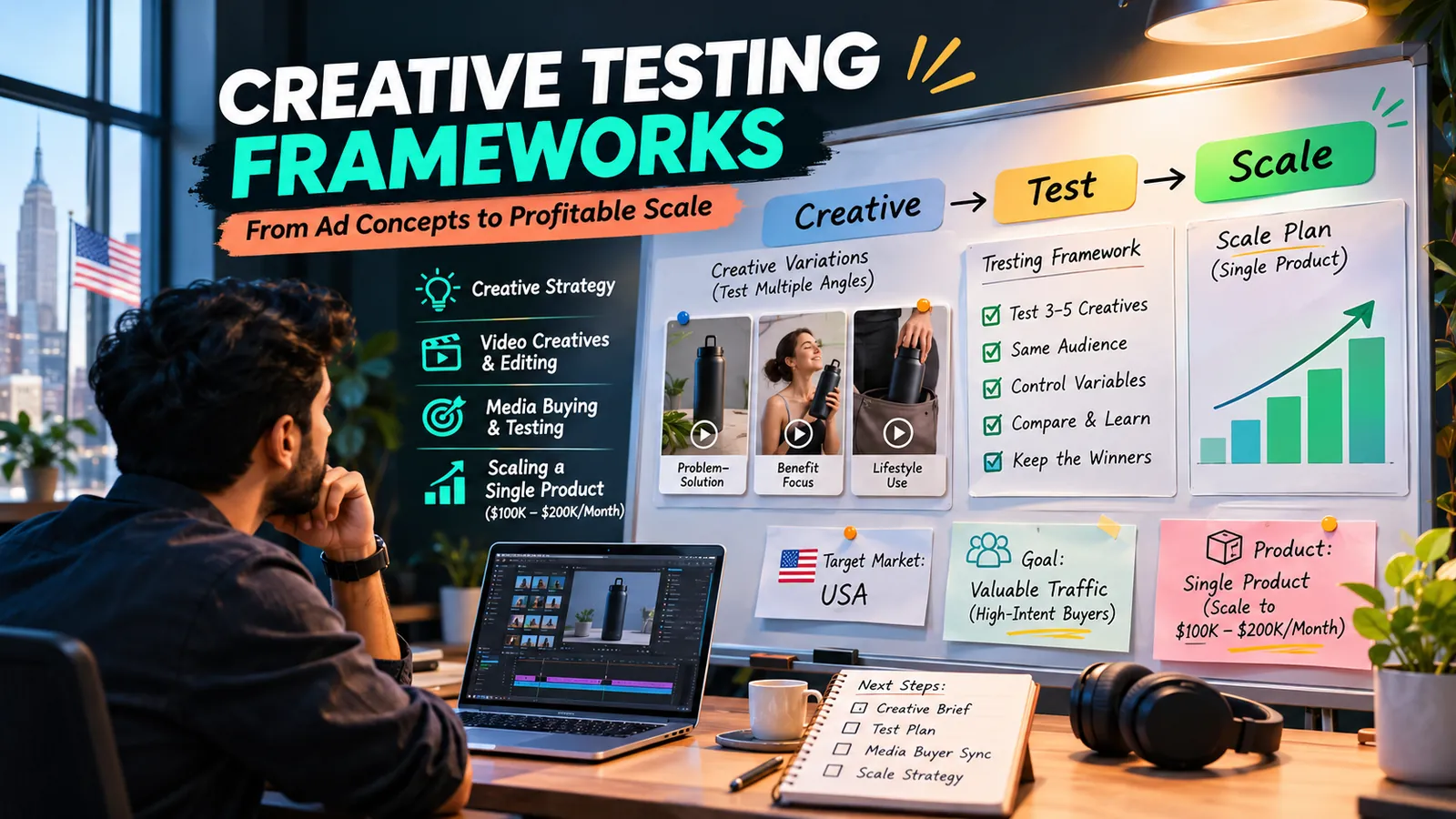
A creative testing framework is a repeatable way to turn a customer insight into an ad concept, set a performance hypothesis, launch a fair comparison, and use the result to decide what to create next.
“It is not a folder full of “winning hooks.” It is a method for learning which message, proof, and presentation actually help the business acquire customers.”
In practice, people use the word “framework” differently. One team may call Founder Story a framework; another calls it a concept or format. That is fine as long as everyone agrees on the level being tested.
| Term | What it means | Example for a haircare brand |
| Customer insight | What a buyer thinks, fears, or wants | “I have tried products that did not work.” |
| Angle | The persuasion route | Restore confidence through a simple routine |
| Framework | The narrative structure | Problem → Solution → Proof → Action |
| Format | How the message is presented | UGC video, founder video, static graphic |
| Hook | The first attention-grabbing idea | “I stopped guessing what my hair needed.” |
| Variation | A changed execution | A new hook with the same body and CTA |
The important distinction: four edits with different opening captions are not the same as four different reasons to buy.
What a Real Creative Brief Teaches Us
For example, in the legal-services brief I reviewed, the audience was not described only by age and gender. The brief started with a person who had just experienced an accident: worried about costs, unsure whom to trust, and overwhelmed by next steps.
That single decision changed the advertising direction. Instead of sounding like a loud legal commercial, the messaging needed to feel calm, direct, and useful.
Beyond the audience profile, the brief looked at previously successful content, patterns competitors were using, and messages that an actual person could deliver on camera. From there it proposed several different approaches, such as a personal-note graphic, a conversational message-style ad, a comparison visual, and a short fact-and-answer video.
Here are the five questions worth stealing from that process—not the client’s creative assets:
- Who is the customer emotionally, not just demographically?
- What has already generated meaningful business results?
- What patterns in the market are overused, and what still feels credible?
- Which distinctly different ideas should be tested next?
- What exactly does the creator or editor need to produce each idea?
However, a planning brief does not automatically tell us whether those new concepts worked. For that, we need an experiment and a performance report.
Creative Strategy vs. Video Editing vs. Media Buying
These roles overlap, but their accountability is not identical. An editor can deliver an excellent first three seconds. The strategist must explain why that opening matters to the buyer. Meanwhile, the media buyer checks whether the resulting conversion is worth its cost.
| Role | Core responsibility | Question to ask |
| Creative strategist | Research, angles, hypotheses, briefs, iterations | What are we learning from the next creative test? |
| Video editor / producer | Footage, pacing, captions, visual proof, versions | Does the execution make the promise clear and believable? |
| Media buyer | Campaign delivery, budgets, measurement, testing | Are we buying profitable or qualified outcomes? |
| Business owner | Offer, margin, fulfillment, customer experience | Can the business afford and deliver this growth? |
For freelancers, this distinction matters. Learning to write a creative hypothesis and read CPA or conversion-rate data makes your editing decisions more valuable. It does not mean you need to claim that you personally managed a $200,000 ad account.
How to Build Your First Testable Creative Hypothesis
How to Build Your First Testable Creative Hypothesis
Start with one performance problem. Suppose a single-product haircare store gets plenty of video views but not enough purchases. A rushed response is “make another UGC ad.” Instead, ask why interest is failing to become confidence before choosing the next concept.
“Hypothesis: A customer-objection video explaining how to use the product may reduce purchase CPA compared with a generic product-demo video, because shoppers are unsure whether it fits their routine.”
As a result, a useful hypothesis should connect three things: the observed problem, the proposed creative change, and the business metric you expect to improve. It should be possible to prove you wrong.
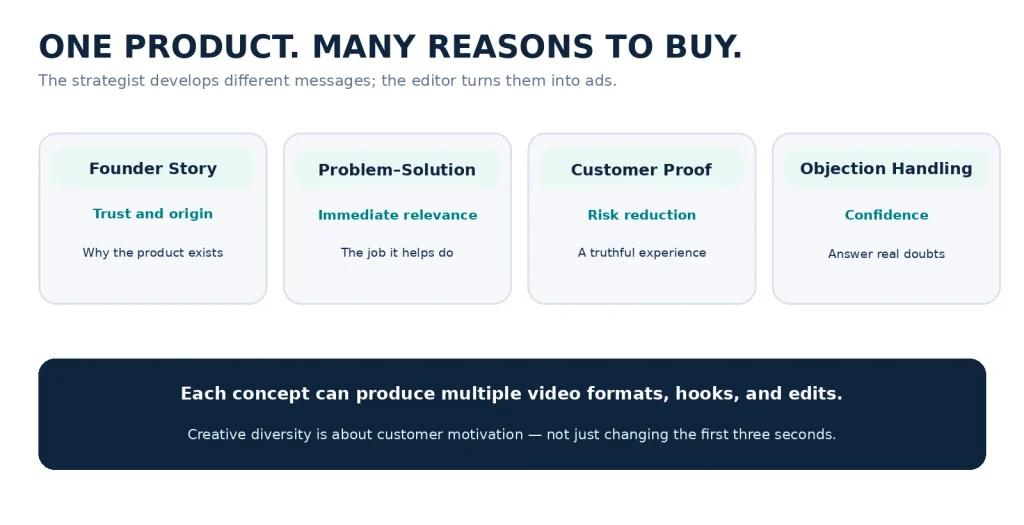
Example: Four Creative Concepts for One Product
| Concept | Opening promise | Type of proof |
| Founder Story | Why this product was developed | A real founder explaining its origin |
| Problem–Solution | A clearer everyday haircare routine | Real product demonstration |
| Customer Story | What using the product feels like | Genuine, permissioned customer experience |
| Objection Handling | Answers about use, fit, and expectations | Demonstration + clear product facts |
Avoid promising dramatic outcomes you cannot substantiate. Particularly in beauty, health, and wellness ads, real experiences, substantiated claims, and accurate disclosures matter more than a visually convincing AI testimonial.
How to Test Creative Frameworks With a Media Buyer
Here is the practical meeting-to-launch process I would use with a media buyer. It is a workflow, not a claim that every Meta account should be structured the same way.
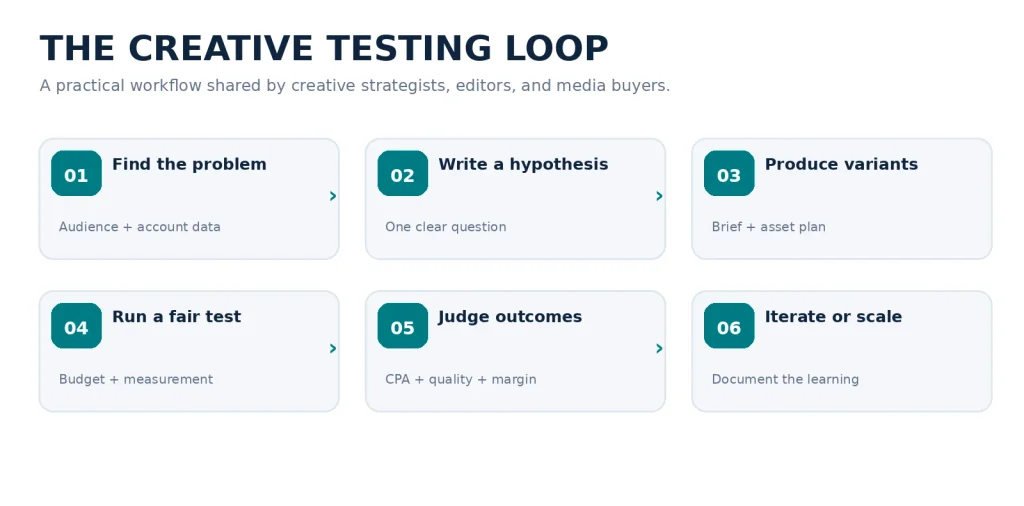
Step 1: Review the Last 30–60 Days of Creative Data
Ask for spend by ad, outbound or link CTR, CPC, landing-page view rate, add-to-cart or lead progression, purchase CPA or qualified-lead cost, ROAS where relevant, and frequency. For video, add thumb-stop or hook metrics and retention. Definitions and available metrics vary, so agree on what is being measured.
Never call an ad a winner just because it received the most attention. A legal lead-generation ad can produce cheap form submissions and still fail to generate qualified cases. An e-commerce video can have a high CTR and a poor purchase CPA.
Step 2: Agree on the Test Question Before Production
For example: “Will a customer-objection message outperform a general product demo on first-purchase CPA?” If the question is about the message, avoid changing the offer and landing page at the same time.
Step 3: Decide Whether This Is a Controlled Test or an Exploration
In Meta Ads Manager, A/B testing and creative testing tools can help structure comparisons and evaluate results. Meta Blueprint describes A/B tests, creative tests, and lift studies as different measurement options. Availability and setup depend on the account and the experiment type.
If you simply launch several new ads into one ad set, Meta may deliver much more spend to one ad than another. That can be useful for exploration, but uneven delivery is not the same as a clean, randomized A/B comparison.
Step 4: Set a Sensible Budget and Evaluation Window
A simple hypothetical exploratory plan is three concepts at $50 per day each for seven days: $1,050 total. That is a planning example, not an official Meta budget recommendation.
If the target purchase CPA is $25, the budget could theoretically produce about 14 purchases per concept at target performance. Fourteen purchases is usually too little to make a confident claim that one framework is universally better. Small budgets can produce directional learning; they do not magically produce statistical certainty.
Step 5: Read the Outcome That Actually Matters
| Ad (hypothetical) | Outbound CTR | Purchase CPA | ROAS |
| Founder Story | 4.2% | $20 | 3.5× |
| UGC Testimonial | 5.8% | $32 | 2.1× |
| Problem–Solution | 3.1% | $23 | 3.0× |
Assume each ad spent $500 and the target CPA was $25. The UGC testimonial attracted the most clicks, but the Founder Story delivered the strongest reported CPA and ROAS. Founder Story is the leading candidate for further validation; Problem–Solution is worth keeping in the mix. We should not scale just because the CTR is highest.
Even here, do not jump to a final answer without checking order quality, new-customer share, attribution consistency, margin, and whether the performance holds with additional spend.
Step 6: Document the Decision—Iterate, Validate, or Pause
At first glance, an underperforming ad might seem like a failed concept. But the idea may still be promising. Maybe the hook attracts the right buyer but the product demonstration is confusing. In that case, keep the angle and change the execution. If a concept repeatedly fails after a fair opportunity, move the budget and production effort elsewhere.
What Video Editors Should Actually Test
In practice, editors often hear “make five variations,” but that instruction is incomplete. Five different variations of what? The most useful approach is to separate concept testing from execution testing.
| Test layer | Keep mostly consistent | Change deliberately |
| Concept / angle test | Offer, landing page, audience rules | Core buyer motivation or message |
| Hook test | Main body, proof, CTA | First 1–3 seconds or opening line |
| Proof test | Angle, offer, CTA | Demo, founder evidence, permitted testimonial |
| Format test | Core claim and offer | Static vs. UGC vs. founder-led video |
| CTA test | Core story and offer | Specific, compliant next-step language |
For editors, the first practical upgrade is to label every delivered ad by concept, hook, format, and version. A filename like HAIR_OBJECTION_UGC_HOOK02_V1 tells the team more than “final-video-new-3.mp4.”
Why a Single Product Can Support $100K–$200K in Monthly Ad Spend
This question comes up often in freelance job descriptions. If a company sells only one hero product, how can it spend $100,000 or $200,000 per month advertising that same thing?
Because the product does not have to change every week. The people, objections, motivations, levels of awareness, creative executions, and buying moments are different. A single skincare, cleaning, or haircare product may have several legitimate use cases and customer segments.
Spending $100,000 in a 30-day month is roughly $3,333 per day. Spending $200,000 is roughly $6,667 per day. The hard question is not whether the platform can spend the money. It is whether additional customers can be acquired at an acceptable contribution cost.
The Math Behind a $100K Month
Assume the store has a $65 average order value (AOV), spends $100,000 on ads, and reports 2.5× attributed ROAS. That would imply $250,000 in attributed revenue and approximately 3,846 orders, before differences in refunds, attribution, and other operational details.
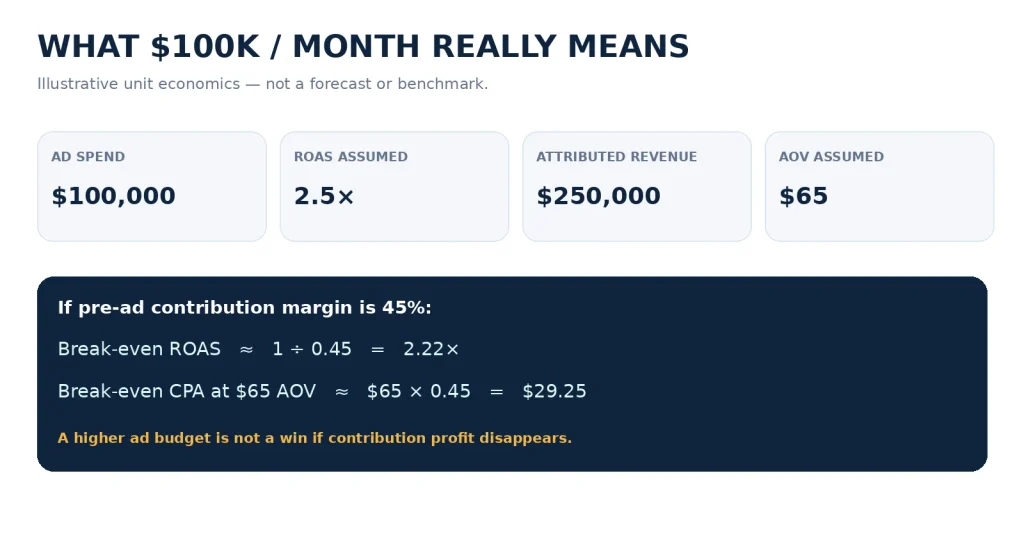
Now add contribution margin. Suppose 45% of each order remains after variable costs other than advertising, such as product cost, shipping, and payment processing. At a $65 AOV, that leaves $29.25 per order to pay for acquisition and contribute to fixed costs and profit. An approximate break-even first-order CPA would be $29.25, and break-even first-order ROAS would be 1 ÷ 0.45, or about 2.22×.
Under those assumptions, 2.5× ROAS may be viable, but the margin of safety is not enormous. These figures are examples, not industry benchmarks, and a business may evaluate customer lifetime value, repeat orders, and cash flow differently.
Why Doubling Budget Does Not Double Profitable Revenue
At $100,000 spend and 2.5× ROAS, attributed revenue would be $250,000. But if the budget rises to $200,000 and ROAS falls to 1.8×, revenue would be $360,000—not $500,000. The company spent an extra $100,000 to generate an extra $110,000 in attributed revenue. With a 45% pre-ad contribution margin, that extra revenue would contribute just $49,500 before the additional $100,000 in ads—a poor incremental trade under this simplified model.
That is why experienced media buyers watch marginal performance, not merely overall reported ROAS.
What the Budget Could Look Like
For teaching purposes, consider allocating 70% to proven acquisition creative, 20% to new concept and iteration tests, and 10% to specific additional opportunities such as re-engagement. This is only a sample allocation, not a universal 70/20/10 rule. Modern broad campaigns can already reach people at different stages without a separate retargeting campaign.
The strategic job is to create a pipeline of fresh ideas while protecting the budget already supporting profitable orders. A creative strategist helps answer: “What will replace or complement today’s winners when their performance changes?”
What Small Businesses Should Do With a Much Smaller Budget
You do not need a six-figure media budget to use a testing framework. In fact, the smaller the budget, the more important it becomes to avoid random creative production.
Choose one clear offer, one well-defined buyer problem, and two or three genuinely different concepts. Use your existing customer questions, returns, reviews, support tickets, and product demonstrations as evidence. Do not manufacture customer proof.
If paid testing is very limited, gather directional feedback from organic posts, on-site behavior, sales calls, and customer interviews before spending more. Organic attention is not equivalent to a paid conversion test, but it can help improve the clarity of the message.
A beginner-friendly weekly cycle is simple: Monday research, Tuesday concepts, Wednesday production, Thursday launch or publish, Friday review. When conversions are sparse, use the learning to improve offers and landing pages rather than repeatedly declaring tiny winners and losers.
The Weekly Meeting I Would Run With a Media Buyer
A productive creative review is not an hour of opinions about which video looks best. It is a 20- to 30-minute decision meeting based on a short scorecard.
Last week: Which ads received meaningful spend, and which generated qualified or profitable outcomes?
Diagnosis: Is the weakness attention, click quality, landing-page conversion, checkout, or economics?
Decision: Which concepts do we scale, iterate, pause, or investigate?
Next test: What one question will the next creative batch answer?
Owner: Who writes the brief, who edits, who launches, and when do we review?
“A useful meeting ends with a testable decision, not just feedback like “make the hook stronger.””
A One-Page Creative Testing Brief You Can Reuse
| Field | Example |
| Business goal | Reduce first-purchase CPA while maintaining contribution margin |
| Audience / insight | Shoppers who want a straightforward routine and clearer product-fit information |
| Current observation | Product demo generates clicks but purchase conversion is weak |
| Hypothesis | Objection-led creative may improve buyer confidence |
| Concept to produce | Real creator explains product use and answers one common question |
| Control conditions | Same offer, landing page, campaign goal, and reporting window |
| Primary metric | First-purchase CPA or qualified-lead cost |
| Secondary metrics | CTR, LPV rate, hold rate, conversion rate, ROAS |
| Test plan | Agreed test type, budget, start/end, minimum evidence |
| Decision rule | Validate with more spend if CPA and quality meet agreed goals |
| Next action | Iterate hook, proof, or format based on the diagnosis |
If you are a freelancer, this brief is something you can bring to a client before opening Premiere Pro or CapCut. It makes the project about business learning, not a random request for more videos.
Ethics, AI Creatives, and U.S. Advertising Trust
AI can help storyboard concepts, generate product-supporting B-roll, create rough drafts, and speed up revisions. But it should not turn a fictional customer experience into a fabricated real testimonial.
The U.S. Federal Trade Commission expects endorsements to be truthful and not misleading, and its consumer-review rule addresses fake or false testimonials. If a creator was paid or has another material connection, appropriate disclosure may also be required. Results-based claims need suitable substantiation, and legal or health-related advertisers may face additional requirements.
The practical standard is easy to remember: show the real product, explain what it actually does, use genuine permissioned proof, and make the next step clear.
Frequently Asked Questions
What is the difference between a creative framework and a creative angle?
An angle is the reason or perspective used to persuade someone. A framework is the repeatable sequence that delivers that perspective. A “convenience” angle can be presented through a Problem–Solution framework or a customer story.
How many creatives should I test in one Meta ad set?
There is no magic number that works for every account. Base the volume on available budget, expected conversion rate, the question being tested, and whether you need fair experimental comparison. More ads without enough evidence can create confusion rather than learning.
Is a high CTR enough to call a video ad a winner?
No. CTR measures response to an ad, not profitability. Follow the customer through the conversion event and check acquisition cost, conversion quality, and margin.
Can I scale Facebook or Instagram ads with one product?
Yes, if there is sufficient demand, a functioning offer and conversion path, reliable fulfillment, and an acceptable customer-acquisition cost. Different creative angles can help reach different motivations, but they cannot rescue poor unit economics by themselves.
Do video editors need media-buying experience?
Not always. But understanding CTR, CPC, CVR, CPA, ROAS, attribution limitations, and creative-testing discipline helps editors make better decisions and communicate with performance teams.
How much should a small business spend on a creative test?
Enough to produce useful observations without risking money the business cannot afford to lose. Start from your target CPA, expected number of conversions, available cash, and desired confidence. If the budget cannot support a conclusive paid test, describe the outcome as directional learning.
Final Thought: Stop Producing Ads Without a Learning Plan
The next time a client asks for ten new videos, do not begin with ten transitions or ten opening captions. Start by asking what the audience still does not understand, what the current account data says, and what the next set of ads is meant to teach the business.
For small-business owners, that means less waste. Video editors develop stronger creative judgment, while freelancers gain the confidence to have more valuable conversations with clients. Meanwhile, media buyers benefit from a healthier pipeline of creative ideas that can support business growth without relying on a single winning ad.
Good creative strategy connects customer psychology, production, measurement, and business economics. When those pieces work together, the ad budget becomes a tool for learning and growth—not simply a number to spend.
Author
Shajib Sutradhar
Creative Strategist • AI Content Creator
I am a professional digital marketer with over 6 years of experience working with international clients on Upwork. Alongside client services, I build passive income platforms and scalable AI advertising workflows. Through my official website Easypreneurship.com and my YouTube channel AI Creative Lab Studio (@AICreativeLabStudioAI), my mission is to provide practical, fluff-free tutorials and strategies for freelancers, e-commerce owners, and students looking to build sustainable digital careers.
🚀 Try Higgsfield AI for Professional Ad Creation
Founder of Easypreneurship.com
📱 WhatsApp: +8801715163076
Further Reading and Official Sources
Meta Blueprint — Designing A/B Tests, Creative Tests and Lift Studies https://formedia.facebookblueprint.com/student/path/219763-ab-test-conversion-brand-lift-course
Meta Blueprint — Ad Creative That Converts: Diversifying Ads https://www.facebookblueprint.com/student/activity/707402
FTC — Endorsements and Testimonials in Advertising https://www.ftc.gov/news-events/topics/truth-advertising/advertisement-endorsements
FTC — Consumer Reviews and Testimonials Rule: Q&A https://www.ftc.gov/business-guidance/resources/consumer-reviews-testimonials-rule-questions-answers
Google Search Central — Creating Helpful, Reliable, People-First Content https://developers.google.com/search/docs/fundamentals/creating-helpful-content