Introduction & Reading Objectives
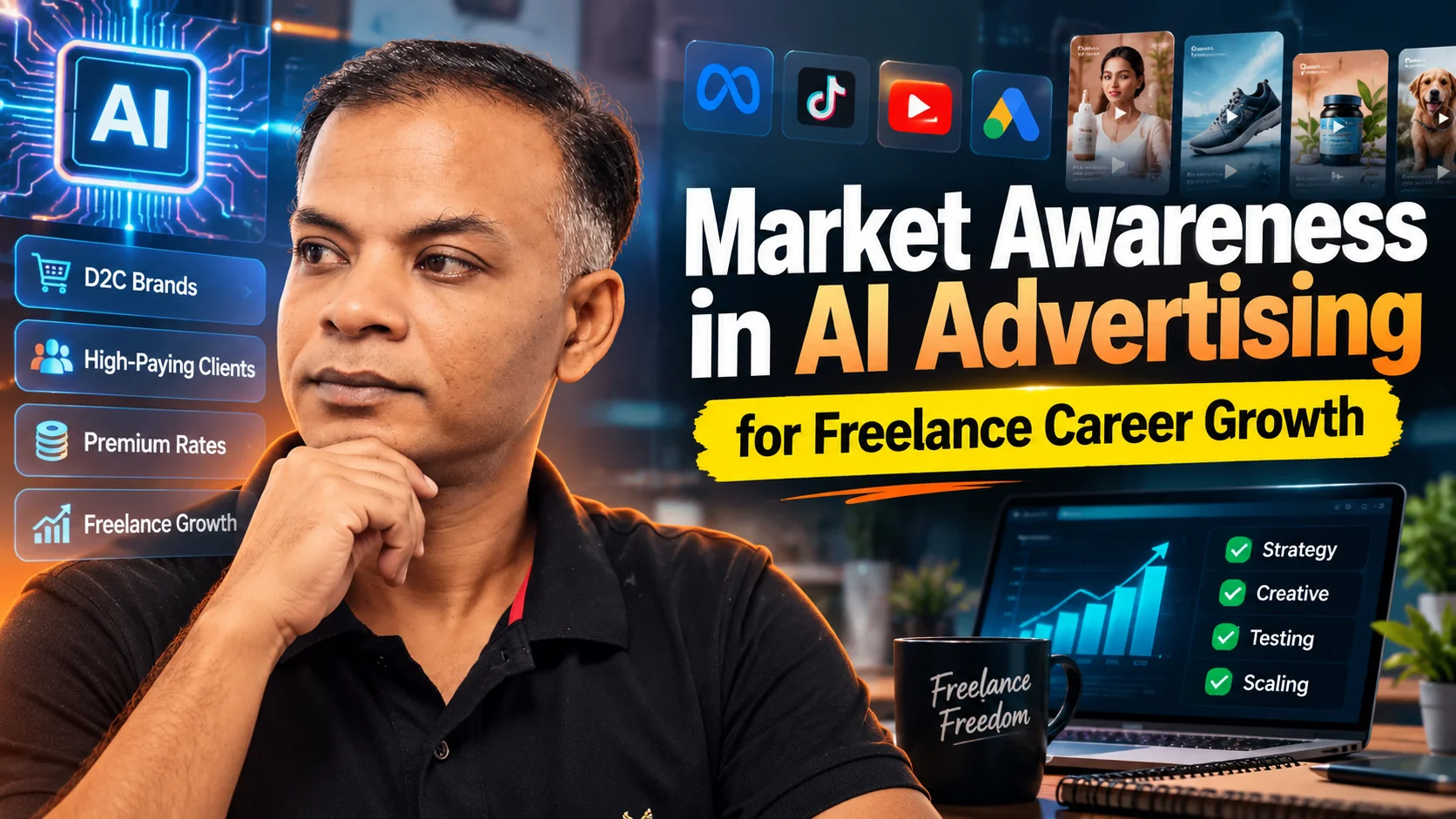
The world of digital marketing and advertising is constantly evolving. What worked a few years ago is completely obsolete today. Especially with the rapid integration of Artificial Intelligence (AI), a massive shift has taken place across freelance marketplaces and local businesses alike. However, even amidst this technological wave, one fundamental truth remains unchanged: Consumer Psychology.
No matter how flashy your AI-generated visuals are or how catchy your clickbait scripts might be, if they do not match your target audience’s current level of understanding, your entire advertising budget will go to waste.
Reading Objectives:
1. Market Awareness: Understand this core advertising industry concept from the ground up.
2. The 5 Levels: Learn how to apply Eugene Schwartz’s 5 levels of market awareness to modern AI advertising workflows.
3. AI vs. Human Strategy: Discover the practical reasons why AI can never fully replace human creative strategists.
4. Hybrid Workflow: Gain a roadmap on how to upgrade your skills to survive freelance marketplaces (like Upwork) and fulfill high-paying client demands.
1. What is Market Awareness and Why Does It Matter?
The most critical element in the advertising industry is Market Awareness. Simply put, it is the level of understanding your target customer has regarding your product, their own problem, and the solutions available in the market.
Historically, brands relied heavily on a Senior Creative Strategist to run a successful ad campaign. The creative strategist’s core job was to use market research techniques to understand human behavior, tap into buying psychology, and compile a Creative Brief. Afterward, the entire team (copywriters, designers, video editors) collaborated to bring that brief to life in the creative production phase.
The AI Illusion
Today, with the widespread adoption of AI, a strange trend has emerged across freelance marketplaces. Both clients and new freelancers have fallen into the trap of demanding that “AI will do everything”.
But the hard reality is quite different. While AI can quickly produce clickbait commercials and flashy visuals, the ultimate question remains: Is your marketing framework actually correct according to market awareness? If the answer is no, those ads will fail to generate revenue.
2. Deep Dive: The 5 Levels of Market Awareness
In his legendary book Breakthrough Advertising, Eugene Schwartz divided customer awareness into five distinct stages. Let’s break down how these levels function and how to deploy them using AI tools:
[Unaware] -> [Problem-Aware] -> [Solution-Aware] -> [Product-Aware] -> [Most Aware]
1. Unaware Level
- Definition: Prospects at this level do not even know they have a problem. They are completely oblivious.
- The Wrong Approach: Trying to sell a product directly to them is the biggest mistake you can make.
- The Correct Strategy: You must first hit a core emotion they are feeling. You have to educate them on a common problem causing that emotion before you can ever introduce a solution.
- AI Application: Use AI generation tools to create highly relatable hooks that mirror daily human habits, frustrations, or universal emotional triggers.
2. Problem-Aware Level
- Definition: The customer realizes they have a problem or a specific pain point, but they have no idea how it can be solved.
- Goal: Focus on the problem, show that you deeply understand their pain, and start introducing answers.
- The Correct Strategy: You must articulate the problem so clearly that the prospect instantly says, “Yes, that is exactly the problem I am having!” Only then do you pivot to the solution.
- AI Application: Utilize AI chatbots like ChatGPT or Claude to generate deeply empathetic, story-driven scripts built entirely around specific customer pain points.
3. Solution-Aware Level
- Definition: The customer knows that solutions or services to their problem exist in the market, but they are unfamiliar with your specific product.
- Goal: Introduce your product as the absolute superior solution to their main problem.
- The Correct Strategy: Call out the specific benefits consumers want. If competitor products offer similar benefits, directly compare them to show why yours does it better. Use success stories, customer testimonials, and influencer reviews as powerful social proof.
- AI Application: Edit AI UGC (User Generated Content) style videos to construct compelling, high-converting social proof frameworks.
4. Product-Aware Level
- Definition: The prospect knows about your product and offer, but they are hesitant, comparing options, or wondering if it is truly the best fit for them.
- Goal: Make your product shine, build deeper trust, and demonstrate its unique features.
- The Correct Strategy: Share specific features and benefits. Introduce a psychological technique called Future Pacing—show them exactly how easy, effective, and complete your solution is by visualizing how it will change their daily lives for the better.
- AI Application: Deploy 3D product animations, claymation, or hyper-realistic AI product showcases to cleanly present the item’s inner workings and immediate results.
5. Most Aware Level
- Definition: These prospects are your hottest audience. They fully know your product, trust your brand, and are ready to buy; they just need a final, tiny push.
- Goal: Close the deal and finalize the purchase.
- The Correct Strategy: Get out of the way. Do not over-explain. Make an irresistible offer, reduce their risk (e.g., money-back guarantees), and provide a crystal-clear Call-to-Action (CTA). Discounts, bonuses, and artificial urgency work best here.
- AI Application: Deploy dynamic AI-powered retargeting ads that deliver hyper-personalized coupon codes, flash sales, or limited-time checkout offers.
3. Market Awareness Matrix: Quick Reference
| Awareness Level | Customer Mindset | Campaign Goal | Actionable Steps & AI Role |
| Unaware | Has no idea a problem exists. | Educate and provoke awareness. | Hook via core emotions and storytelling. |
| Problem-Aware | Knows the pain, lacks a solution. | Articulate and validate the problem. | Deep dive into specific pain points. |
| Solution-Aware | Knows solutions exist, doesn’t know you. | Position your solution as superior. | Use reviews, comparisons, and UGC. |
| Product-Aware | Knows your product, still hesitant. | Build ultimate trust and showcase value. | Feature future pacing and live demos. |
| Most Aware | Ready to buy, price/timing sensitive. | Close the sale immediately. | Offer discounts, urgency, and clear CTAs. |
4. Traditional Advertising vs. The AI Advertising Era
In the past, market research had to be done entirely manually. Agencies spent days scanning Amazon reviews, parsing Reddit threads, analyzing blog comments, and studying YouTube landing pages to map out real human behaviors. At the end of the day, a client’s main goal has always been simple: increase revenue.
This begs the question: Will AI completely replace the manual skills we previously relied on? Is human talent obsolete?
The answer is a definitive No.
Why AI Cannot Replace Human Strategy
While freelance marketplaces are shifting, the core of advertising relies on real feelings for real avatars. AI can analyze patterns, optimize data, and regurgitate structures, but it lacks true empathy. It cannot feel the real-world frustrations of a human consumer. A human creative strategist is still required to steer the ship.
Why the Market is Leaning Towards AI Advertising
- Quick Production & Quick Testing: Advertising budgets are no longer reckless. Traditional workflows had high dependencies—if one step halted, the entire pipeline froze. AI breaks this bottleneck.
- Ecosystem Automation: Clients and agencies now use AI ecosystems to bypass manual production, allowing them to test dozens of ad variations simultaneously at a fraction of the cost.
5. Essential Skillsets for the Modern AI Marketer
The nature of freelance work has fundamentally changed, and those failing to adapt are losing their edge. In this new era, your traditional skills must merge with AI command workflows.
To command premium rates, you must master these upgraded skill setups:
- Creative Strategy: Architecting ad frameworks based on data and consumer psychology.
- Script Writing: Driving AI tools to write fast, high-converting scripts with solid hooks, bodies, and CTAs.
- Creative Production: Seamlessly generating visual components using advanced AI video generators.
- Creative Trends: Spotting social media trends instantly and mapping them into automated production flows.
6. Case Study: What Do Clients Actually Want?
To understand the current state of the global market, look no further than this typical D2C E-commerce job posting sourced from modern freelance ecosystems:
Job Title: Full-time Video Editor (40+ hrs/week) for D2C E-commerce Brands
Requirements:
* Must be fluent in English (ideally able to edit ads in foreign languages like German).
* Proven D2C ad & paid marketing editing experience is mandatory.
* Experience using Frame.io for real-time reviews and feedback.
* Long-term commitment, full-time availability.
* Crucial Requirement: Must know how to generate AI ads (AI UGC, Claymotion, etc.).
* Special Warning: (!) It is critical to NOT use AI in the application text.
See the Direct Responding Ads Below
The Great Paradox
The reality of the market is beautifully ironic: Clients want everything inside the video to leverage cutting-edge AI production, yet they refuse to read an AI-generated, copy-pasted job application. They want an authentic human professional who knows how to control AI tools to achieve maximum performance.
To win these roles, your toolkit must consist of:
- Technical Mastery: Advanced Audio Editing & Color Grading.
- AI Generation: AI-Generated Video & Comprehensive Post-Editing.
- Marketing Strategy: Video Commercial & Paid Ad Strategy execution.
- Psychology: Above all, a deep mastery of Market Awareness and Audience Psychology.
Conclusion: The Future Roadmap
Video advertising is no longer just about chopping up clips or putting nice filters on visuals. It requires an end-to-end understanding of marketing funnels and human behavior. Those who master the synthesis of Market Awareness and AI workflow production will hold all the cards for the next 5 years.
9. About the Author
Shajib Sutradhar
Creative Strategist • AI Content Creator
I am a professional digital marketer with over 6 years of experience working with international clients on Upwork. Alongside client services, I build passive income platforms and scalable AI advertising workflows. Through my official website Easypreneurship.com and my YouTube channel AI Creative Lab Studio (@AICreativeLabStudioAI), my mission is to provide practical, fluff-free tutorials and strategies for freelancers, e-commerce owners, and students looking to build sustainable digital careers.
🚀 Try Higgsfield AI for Professional Ad Creation
Founder of Easypreneurship.com
📱 WhatsApp: +8801715163076