Executive Summary & Personal Introduction
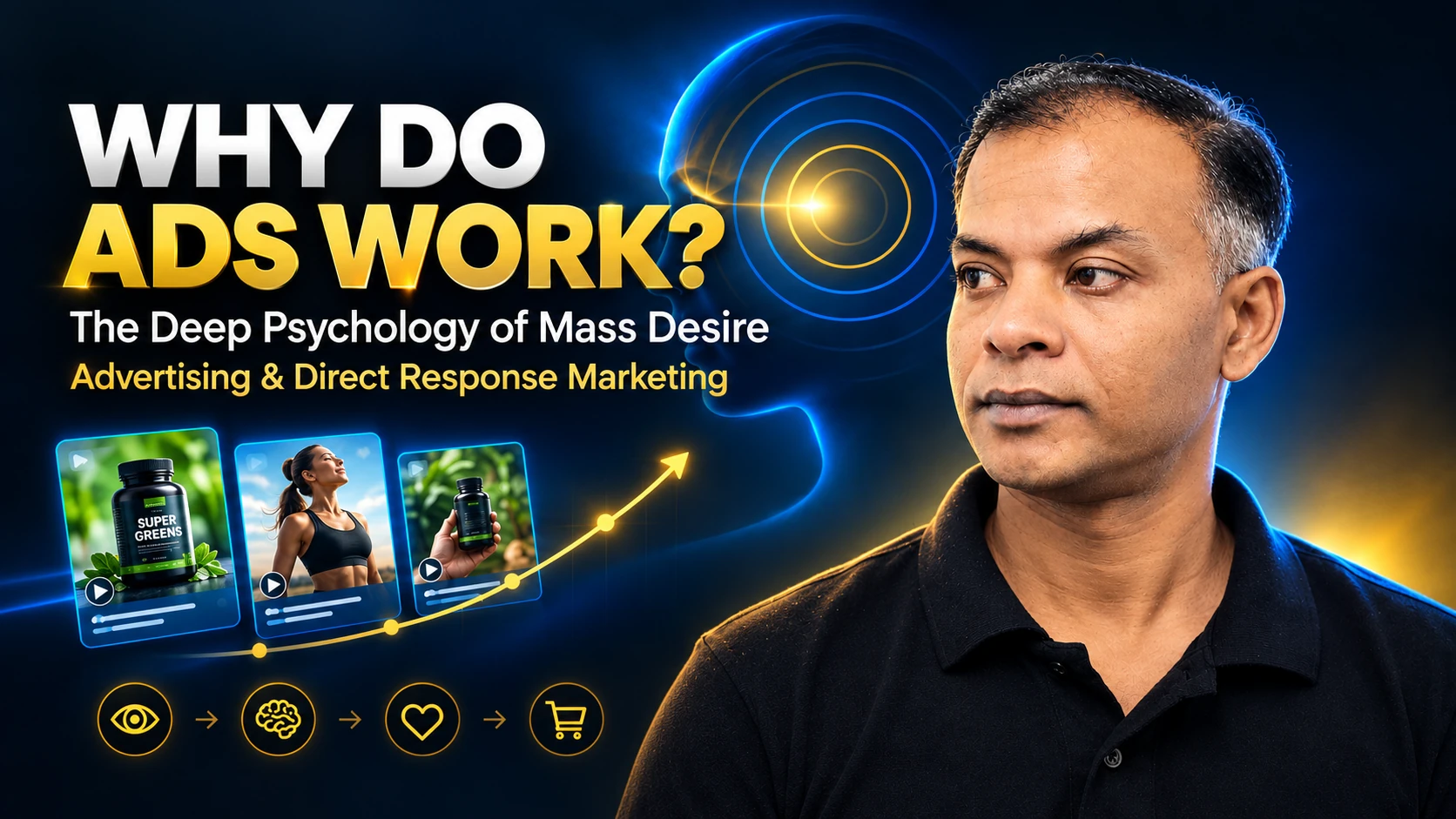
When I first stepped into the advertising industry years ago, I constantly wrestled with a fundamental, high-stakes question: Why do some advertisements generate millions of dollars in revenue while others fail to get a single click? Mastering Mass Desire in Advertising is ultimately what separates winning campaigns from losing ones. As a child watching television commercials, I was captivated by how a simple 30-second clip could persuade adults to purchase specific cars, breakfast cereals, or soft drinks. Later, as I transitioned into a professional freelancing career, I had the privilege of collaborating with high-performing U.S. ad agencies, top-tier media buying teams, and direct-response creative strategists. Through internal agency SOPs, exhaustive video breakdowns, multi-million dollar campaign audits, and classic marketing literature, the underlying mechanics finally became crystal clear.
This masterclass is designed to share those exact insights with media buyers, creative strategists, ad video editors, copywriters, and solo entrepreneurs who want to stop guessing and start building predictably profitable creative frameworks.
This comprehensive guide serves as Part 1 of our 6-Part Advertising Psychology Masterclass Series:
- Market Desires (Understanding the primal force driving all commerce)
- Market Awareness (Mapping how conscious your audience is of their problem)
- Understanding Unaware + Awareness Levels (Reaching cold audiences effectively)
- Market Sophistication (Navigating competitive and crowded markets)
- Market Identification (Aligning your offer with consumer identity)
- Market Belief (Bridging the gap between skepticism and conviction)
In this definitive guide, we dive deep into Market Desires—the foundational force behind every profitable advertising campaign ever created.
1. What Is Mass Desire? (Decoding Eugene Schwartz’s Core Principle)
In his legendary 1966 masterpiece Breakthrough Advertising, direct response pioneer Eugene Schwartz laid down the supreme law of performance marketing:Mass Desire = “The public spread of a private want.”
When millions of individuals privately harbour the same unfulfilled longing, insecurity, ambition, physical pain, or frustration, those individual feelings accumulate into a massive, invisible ocean current—a Mass Desire. Advertising does not generate this force from thin air; advertising simply harnesses it.
Mass desire is a widely shared human want that already exists within a market. It might be the desire for comfort, financial security, confidence, convenience, or social acceptance. Effective advertising connects a product to that desire through a relevant message, a credible promise, and supporting proof.
For example, a customer buying a haircare product may not simply want healthier-looking hair. They may also want a simpler daily routine or greater confidence in their appearance. Understanding that motivation helps marketers develop more meaningful creative angles.
The Golden Rule of Advertising
You CANNOT CREATE desire. You can ONLY CHANNEL pre-existing desires onto your specific product or service.
Amateur marketers waste millions of dollars attempting to educate the market or force consumers to care about a brand-new concept they have no innate interest in. Elite performance marketers, conversely, act like hydroelectric dams: they locate an existing, raging river of public desire and redirect its immense energy through their sales funnels and ad creatives.
Needs vs. Wants vs. Desires: A Psychological Dissection
To improve conversion rates, one must understand the distinct psychological boundaries between basic human needs, conscious wants, and deep-seated desires.
| Category | Psychological Definition | Real-World Example |
|---|---|---|
| Need | The raw biological or functional requirement necessary for basic operation or survival. | “I need hydration to survive.” |
| Want | The conscious, surface-level preference for a general category of solution. | “I want a cold, sweet beverage.” |
| Desire | The emotionally charged, highly specific outcome tied directly to status, transformation, or identity. | “I desire an iced artisan matcha latte from an aesthetic local café so I feel trendy, healthy, and focused for my workday.” |
2. How Desires Are Born: The Two Core Forces
To anticipate market shifts, spot viral angles before competitors, and craft durable creative strategies, marketers must master the two fundamental forces that give birth to consumer desire:
Force #1: Permanent Forces (The Eternal Drivers)
Permanent forces stem from immutable aspects of human biology, evolutionary psychology, and persistent technological friction. They generate stable, recurring desires that remain constant across generations and cultures.
1. Mass Instincts
Deeply ingrained human drives hardwired into our DNA for survival, social positioning, and reproduction:
- Physical Vitality & Health: The primal drive to eliminate pain, retain youthful energy, avoid disease, and live longer.
- Sexual Attractiveness & Grooming: The drive to attract high-value partners, maintain social appeal, and optimize physical aesthetics.
- Financial Security & Wealth: The instinct to hoard resources, secure protection against economic volatility, and attain financial dominance.
- Social Status & Recognition: The innate desire to climb hierarchical ladders, gain peer admiration, avoid shame, and display power.
2. Technological Problems
Chronic daily friction created by modern infrastructure, devices, and operational processes:
- Slow computer boot times, battery degradation, tax filing complexities, car engine maintenance, software bugs, and messy digital file management.
Force #2: Forces of Change (The Catalysts of Emerging Markets)
While permanent forces remain static over centuries, Forces of Change create sudden, massive surges of brand-new desires or drastically reshape existing ones overnight.
1. Style Trends
Rapidly shifting aesthetic norms, cultural tastes, and lifestyle preferences.
- Examples: The sudden rise of minimalist Scandinavian interior design, street-wear culture, athleisure apparel, or vintage film photography aesthetics.
2. Mass Education
Societal absorption of new scientific knowledge, technological breakthroughs, or health research.
- Examples: Widespread public education regarding gut microbiome health, cold-plunge recovery therapy, biohacking, or artificial intelligence productivity tools.
3. Cultural Shifts
Fundamental transformations in societal values, ethics, family structures, or work environments.
- Examples: The global transition toward remote work flexibility, mental health prioritization, plant-based nutrition, and eco-friendly sustainability.
3. The Three Universal Desire Categories
Every mass desire—whether thousands of years old or birthed yesterday by a viral cultural shift—fits squarely into one of three universal categories:
Category 1: Physical Desires
Physical desires center entirely around the biological experience of the body. When marketing products in this category, direct response ads must evoke tactile, sensory, or physiological relief.
- Pain Relief: Freedom from chronic back pain, joint stiffness, migraines, or insomnia.
- Sensory Pleasure: Gourmet taste profiles, luxury aromatherapy, ultra-soft bedding materials, and tactile comfort.
- Aesthetic & Athletic Transformation: Achieving visible abdominal muscles, clear glowing skin, athletic stamina, and youthful skin elasticity.
Category 2: Material Desires
Material desires revolve around resource accumulation, efficiency, tangible assets, and public indicators of prosperity.
- Wealth & Income: Stock market portfolio growth, real estate returns, secondary income streams, and business profit expansion.
- Status Symbols: Luxury timepieces, high-performance vehicles, designer apparel, and prime real estate addresses.
- Convenience & Efficiency: Automation, time-saving software, automated meal delivery, and household labor reduction.
Category 3: Emotional & Social Desires
Emotional and social desires are the most powerful levers in direct response advertising, as they deal with internal identity and interpersonal relationships.
- Connection & Intimacy: Romantic partnerships, deep friendships, family harmony, and overcoming social isolation.
- Acceptance & Belonging: Peer group approval, professional community inclusion, and cultural alignment.
- Power & Mastery: Executive authority, industry influence, personal autonomy, self-actualization, and high-level skill mastery.
4. Permanent vs. Trending Desires — Navigating Longevity & Volatility
To build high-ROI performance marketing campaigns that sustain long-term growth, advertisers must strategically balance permanent core desires against fast-moving trending desires.
Permanent Desires (The “Big Three” Core Markets)
The core pillars of direct-response commerce are Health, Wealth, and Relationships. Campaigns built around these pillars can run for years without losing structural relevance.
- Health: Weight loss, muscle growth, restorative sleep, anti-aging, mental clarity.
- Wealth: Real estate investing, career advancement, cost reduction, passive income generation.
- Relationships: Dating mastery, marriage counseling, parenting guides, social confidence.
- Strategic Application: Build backend product suites, evergreen sales funnels, and foundational brand messaging around these eternal drivers.
Trending Desires (High-Velocity Opportunities)
Trending desires offer massive, short-term surges in conversion rates and extraordinarily cheap media buying opportunities, but carry steep decay curves.
- Examples: Cryptocurrency bull-run crazes, TikTok viral trends, seasonal holiday rush events, or breakthrough AI software adoption.
- Strategic Application: Capitalize on trending desires using aggressive front-end ad creative angles and hooks, then systematically bridge those newly acquired customers into evergreen backend product lines.
5. Deconstructing Your Offer: Physical Product vs. Functional Product
One of the most transformative breakthroughs for a creative strategist is recognizing that every item you market consists of TWO distinct products simultaneously:
THE PRODUCT ARCHITECTURE
1. The Physical Product (Specs, Hardware & Features)
- Components: Brushless motor, carbon fiber casing, 120V circuit, precise dimensions.
- Strategic Role: Justifies the price point, satisfies logic, and provides proof.
2. The Functional Product (The Transformation & Emotion)
- Outcome: Silky, red-carpet, salon-quality hair achieved in 5 minutes at home.
- Strategic Role: Triggers mass desire, crafts the vision, and closes the sale.
The Physical Product (Features & Specifications)
In fact, the physical product consists of raw materials, hardware specifications, manufacturing processes, dimensions, and software features.
- Its Strategic Role in Advertising: Logic and Justification. It serves as the rational mechanism that allows the prospect’s analytical brain to justify an emotional purchase to themselves, their spouses, or their business partners.
The Functional Product (The Outcome & Emotional Benefit)
The functional product is the real-world transformation, emotional state, status elevation, or time savings experienced after purchasing.
- Its Strategic Role in Advertising: Persuasion and Conversion. This is what the consumer is actually spending money to acquire.
The Golden Rule for Creative Strategists: Never spend 80% of your ad video talking about the carbon fiber casing, motor wattage, or microchip processor. Spend more time demonstrating the customer benefit, and use product features to support your claims. the stunning, celebrity-style hair transformation, and use the technical specs briefly to prove why the transformation works so reliably.
6. How to Research, Uncover, and Evaluate Mass Desire
High-converting direct response angles are never guessed; they are uncovered through rigorous qualitative market analysis and validation frameworks.
Step 1: Desire Mining & Qualitative Research
To capture the precise language of customer desire, creative teams must audit real consumer conversations across digital channels:
- E-Commerce Review Scraping: Analyze 1-star and 5-star reviews on Amazon, Trustpilot, and Shopify stores. Look for contrast: 1-star reviews reveal deep pain points; 5-star reviews reveal functional desire outcomes.
- Social Listening: Monitor niche subreddits, YouTube comments, and TikTok comment sections. Extract phrases containing high emotional velocity:
- “I was searching everywhere for something that…”
- “I was completely tired of wasting money on…”
- “I finally found something that makes me feel…”
- Ad Library Breakdown: Search the Meta Ad Library, TikTok Creative Center, and Google Ads Transparency Center for competitor creatives running continuously for over 90 days. Long-running ads can reveal useful creative patterns, but their duration alone does not prove profitability.
Step 2: Testing Desire Power (The 3-Dimensions Framework)
Before allocating production budgets or media spend, rate candidate desire angles on a scale of 1 to 10 across three critical dimensions:
- Urgency: How desperate is the target audience to resolve this feeling or attain this outcome right now? (e.g., Severe toothache relief scores 10/10; buying new patio furniture scores 4/10).
- Staying Power: Will this desire remain intensely strong for years, or will it evaporate in three weeks when cultural attention shifts?
- Scope: How many millions of potential buyers share this exact desire? Is the market broad enough to support massive ad scaling?
Step 3: Selecting the Dominant Desire Angle
Identify the single desire angle that scores highest across all three dimensions. Center your primary ad hooks, video scripts, headlines, and landing page hero sections around this single dominant desire. Do not dilute the campaign by attempting to target four distinct desires in a single ad.
7. The Direct Response Playbook for Marketers & Ad Editors
To translate mass desire theory into scalable ad assets, follow these fundamental rules of direct response creative execution:
Rule 1: Be a Desire Detective
Constantly observe cultural dynamics, emerging consumer frustrations, and online discourse. Elite performance marketers do not sit in a room trying to invent clever slogans; they spend hours listening to how real people describe their problems.
Rule 2: Why Specificity Matters in Advertising
Generic promises fail to capture attention in noisy ad feeds. Do not merely promise “better skin”—promise “a 10-second morning routine that clears stubborn hormonal breakouts without drying out your skin.” Specificity builds credibility and makes the functional desire feel achievable.
Rule 3: Channel, Never Create
When crafting short-form video hooks for TikTok, Meta, or YouTube Shorts, hook the viewer by calling out an existing desire they already think about daily. Do not spend precious video seconds trying to educate cold users on why they should care about an unfamiliar concept.
Rule 4: Systematically A/B Test Desire Angles
Structure creative testing batches by varying the underlying emotional driver across distinct ad angles, rather than making minor visual tweaks:
- Angle A (Status & Elegance): “Look effortlessly polished and executive-ready in every morning meeting.”
- Angle B (Convenience & Time-Saving): “Get ready in 3 minutes flat without ever needing an iron or steamer.”
- Angle C (Physical Comfort): “Ultra-breathable performance fabrics that stay cool and dry through 12-hour workdays.”
“Want to put these psychological frameworks into practice? Check out our complete guide on Higgsfield AI for Professional Advertising: How to Create Product Ads & Build a Career in AI to start generating high-converting AI video ads today.”
8. Conclusion & What’s Coming Next
Mastering Market Desire elevates advertising from creative guesswork into an empirical, high-yield system. When you stop trying to manufacture consumer interest and instead channel preexisting market momentum, you can develop more relevant creative hypotheses and make better-informed testing decisions.
In Part 2 of this Advertising Psychology Masterclass Series, we will examine Market Awareness—the art of mapping how conscious your audience is of their problem, and how to structure cold traffic campaigns for prospects ranging from Completely Unaware to Most Aware.
9. About the Author
Shajib Sutradhar
Creative Strategist • AI Content Creator
I am a professional digital marketer with over 6 years of experience working with international clients on Upwork. Alongside client services, I build passive income platforms and scalable AI advertising workflows. Through my official website Easypreneurship.com and my YouTube channel AI Creative Lab Studio (@AICreativeLabStudioAI), my mission is to provide practical, fluff-free tutorials and strategies for freelancers, e-commerce owners, and students looking to build sustainable digital careers.
🚀 Try Higgsfield AI for Professional Ad Creation
Founder of Easypreneurship.com
📱 WhatsApp: +8801715163076