If you are a freelance video editor, creative strategist, or digital marketer looking to prove to clients that you do more than just basic editing—that your focus is entirely on driving sales, maximizing ROI, and scaling their business—then this in-depth guide is for you. Especially for those working with direct-response and e-commerce brands, understanding the deep concepts behind the “Rule of One“ is an absolute game-changer.
In this article, we will explore how this single framework can completely transform the quality of your deliverables, how you can effortlessly convince local or international clients, and how to skyrocket sales through high-converting direct-response video advertising.
1. What is the Role of the “Rule of One” in Direct-Response Advertising?
The biggest and most common mistake in digital marketing and performance advertising is trying to say everything within a single ad. Clients or e-commerce brands often want to cram 10 product features, 20 benefits, and their entire brand history into a single 15-to-30-second video ad or landing page (LP). But in marketing, when you try to speak to everyone, you end up speaking to no one.
Confusion Kills Conversions
- When your ad or landing page tries to do too much at once, the user becomes mentally confused [cite: 1].
- As a result, it becomes completely unclear who the product is actually for and what specific problem it solves [cite: 1].
The Core Philosophy of the “Rule of One”
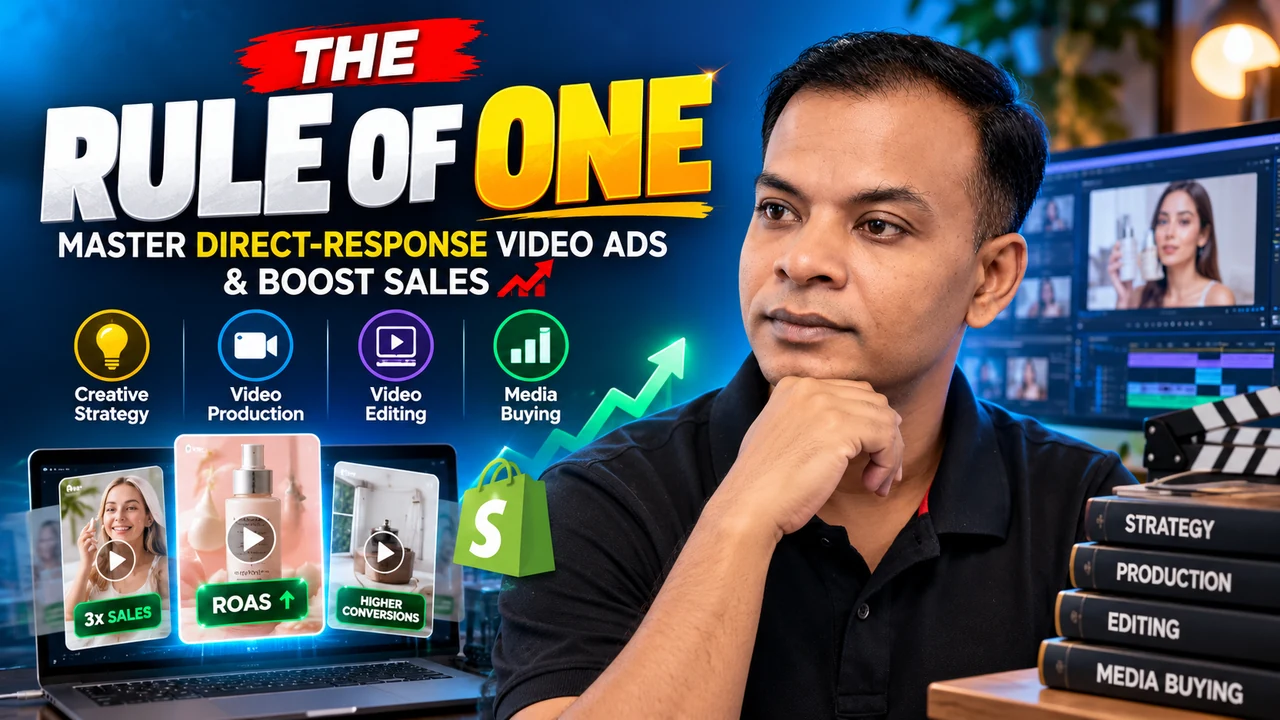
The core lesson from Eugene Schwartz’s famous book Breakthrough Advertising is aligning your marketing message with the pre-existing desires and demands already running through your customer’s mind. The “Rule of One” executes this exact principle. Its core pillars are:
- One Avatar [cite: 1]
- One Desire [cite: 1]
- One Message [cite: 1]
The primary goal of a direct-response ad is to compel the customer to take immediate action (such as clicking ‘Add to Cart’ or ‘Buy Now’). When you stop cramming hundreds of ideas into a single ad and instead focus entirely on one specific pain point and its single solution, you build profound psychological belief in the customer. The stronger that belief becomes, the higher the likelihood that they will convert [cite: 1].
2. Why Understanding This Concept Secures Clients and Drives Freelance Success
There are thousands of freelancers and video editors out there who can edit videos with smooth transitions, stunning color grading, and fancy effects. But when brand owners and e-commerce founders hire freelancers or agencies, what is their primary underlying fear?
“Can this editor actually pull money out of my customers’ pockets and make my ads profitable?”
Why Freelancers Must Master This Concept
- Understanding Consumer Psychology Over Just Products: Ordinary freelancers simply read a script and cut clips together. But a smart freelancer knows who the ad is actually built for. When you speak to a client on a discovery call or pitch on Upwork by saying—“I don’t just edit videos; I construct creative hooks and angles targeting your avatar’s Daily Struggle or Ideal Outcome”—the client immediately realizes you are a profit generator, not just an editor.
- Moving Past Generic Niches: Most freelancers think “Health and Wellness” or “Skincare” is a specific niche. However, the Rule of One teaches us that even these are far too general [cite: 1]. For example, targeting “people with knee pain” is too broad; your avatar must be hyper-specific—like Sarah, who just underwent knee surgery, wasted thousands of dollars on physical therapy that failed, and now needs a holistic solution fitting into her everyday life [cite: 2]. A freelancer who masters this deep psychology is head and shoulders above the competition.
- Conversion-Driven Mindset: When you demonstrate that your editing and visual hooks directly trigger the user’s emotional pressure points, clients understand that you care about business growth. This makes landing repeat work and high-ticket retainer clients effortless.
3. The Ultimate Weapon: How to Convince Business Owners and Demonstrate Value
The hardest part of freelancing is convincing clients why you are different and why you deserve higher rates. To successfully persuade a business owner, follow these steps:
A. Expose Their Current Loss Points
Tell the client: “When you showcase multiple product features across your ad simultaneously, your customers get confused. Because ‘Confusion Kills Conversions,’ your ad spend is literally going down the drain, as users cannot figure out who the product is meant for [cite: 1].”
B. Present the “Rule of One” as the Solution
Pitch the client that you will build creative assets for every ad or landing page centered around one single avatar, one desire, and one core message [cite: 1]. When a single, laser-focused message builds absolute belief in the viewer, their Cost-Per-Acquisition (CPA) drops significantly while Return on Ad Spend (ROAS) scales.
C. Speak the Language of Business and Psychology
Business owners care strictly about numbers, profit, and loss. Avoid getting bogged down in technical editing jargon; instead, speak their language—conversion rates, consumer psychology, emotional triggers, and scaling. When an entrepreneur sees that you understand their sales funnel and profit margins, they won’t hesitate to hire you at premium rates.
4. Scaling Sales in Direct-Response Ads: The Game of Angles and Hooks
The secret sauce to generating high sales volume in direct-response advertising is mastering the creation of powerful angles and hooks.
The Mathematical Formula for an Angle:
Angle = Emotional Trigger + [Daily Struggle OR Ideal Outcome]
This operates through two main pathways:
- Problem / Daily Struggle: Highlighting the current pain your customer is facing and what makes their situation feel like absolute hell.
- Aspirational / Ideal Outcome: Merging the customer’s current emotional state with their ultimate dream state.
Real-World Example: Why Broad Avatars Fail vs. “Real Avatars” Win
Imagine you are building ads for a brand selling an at-home recovery tool [cite: 2].
- The Wrong Approach (Broad Avatar): Targeting “Women, age 35+, struggling with knee pain.” This is far too generic and will never drive high-tier conversions [cite: 2].
- The Right Approach (Rule of One & Real Avatar): Your avatar has a concrete identity. For instance, Sarah—who just got out of knee surgery, wasted $2K on failed physical therapy, and now wants a holistic solution that seamlessly fits into her day-to-day life [cite: 2]. Her specific pain: she can’t ice skate with her friends anymore, which destroys a core part of her identity [cite: 2].
When your video visuals, scripts, and hooks speak directly to this hyper-specific person’s emotions, your ad transforms into a trust-building machine that skyrockets sales [cite: 1].
5. The Video Editor’s Role: Transitioning from Order-Taker to Creative Strategist
In direct-response marketing, a video editor is never just a technical operator—they are front-line marketing architects. Modern performance video editing encompasses several key responsibilities:
A. Controlling Hooks and Visual Psychology
The first three seconds of a video ad dictate everything. An editor must understand which emotional trigger or daily struggle needs to hit the viewer right at the start. Avoid the broad avatar trap and visually showcase specific pain points or desires immediately.
B. Eliminating Confusion to Keep Messages Crystal Clear
Never weaken your core message by stuffing the video with unnecessary graphics, competing promises, or extraneous information [cite: 1]. The pacing and rhythm must be tuned so that one single, unmistakable message etches itself into the viewer’s subconscious.
C. Testing and Iterating Creative Variations
In performance marketing, you cannot scale a brand on a single ad. Editors must know how to build multiple hook and body variations so media buyers can test and isolate the ultimate winning creative.
6. Why This Philosophy is a Career Turning Point for Freelancers
If you want to survive and thrive in the freelance marketplace, you must evolve from a commodity “service provider” into an indispensable “growth strategist.”
- If you pitch yourself by saying—“I am good at Adobe Premiere Pro”, clients will try to squeeze your rates down to pennies.
- If you pitch yourself by saying—“I craft direct-response video creatives using the Rule of One framework that target customer emotions and elevate conversion rates”, clients will gladly retain you month after month.
Conclusion
To survive and dominate in modern digital marketing, you must step beyond traditional frameworks and master consumer psychology alongside the power of the Rule of One. When you can walk into a client meeting and guarantee a focus on business scale, revenue, and deeper customer resonance, you will never face a shortage of high-paying work. Start upgrading your mindset from basic editing to conversion strategy today, and position yourself as the market’s most sought-after creative strategist!
7. About Author
Shajib Sutradhar
Creative Strategist • AI Content Creator
I am a professional digital marketer with over 6 years of experience working with international clients on Upwork. Alongside client services, I build passive income platforms and scalable AI advertising workflows. Through my official website Easypreneurship.com and my YouTube channel AI Creative Lab Studio (@AICreativeLabStudioAI), my mission is to provide practical, fluff-free tutorials and strategies for freelancers, e-commerce owners, and students looking to build sustainable digital careers.
🚀 Try Higgsfield AI for Professional Ad Creation
Founder of Easypreneurship.com
📱 WhatsApp: +8801715163076